Shaggy scalycap
Pholiota squarrosa
Type: Gilled mushroom
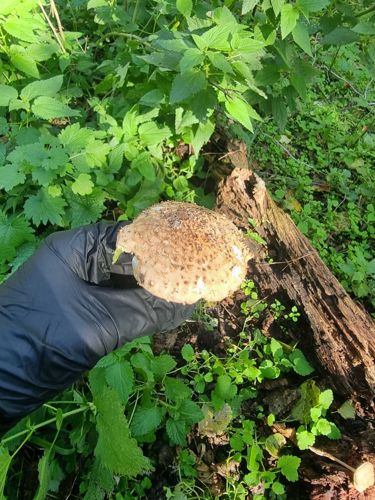
Physical Characteristics
Cap: 5-15 cm wide, convex, becoming broadly convex or almost flat; surface yellowish-brown to orange-brown, covered with prominent, recurved, dark brown to blackish scales, especially dense towards the center. Gills: Attached (adnexed) to slightly descending (decurrent); yellowish at first, becoming rusty brown with age. Stem: 5-15 cm long, 1-2.5 cm thick, roughly equal or slightly tapering towards the base; surface also covered with shaggy, recurved scales below the ring, smooth above it; color similar to the cap; often has a persistent, membranous ring that may break apart with age. Spore print: Rusty brown. Flesh: Whitish to yellowish, firm.
Habitat & Growing Conditions
Typically found in dense clusters or groups on the decaying wood of hardwoods, particularly deciduous trees, but occasionally on conifers. It can grow on stumps, logs, or even at the base of living trees, acting as a saprophyte or weak parasite.
Season & Fruiting Time
Late summer to late autumn, often fruiting after periods of rain.
Similar Looking Species
Several species of Pholiota can look similar. Pholiota squarrosoides (scaly Pholiota) is very similar but has a more viscid (sticky) cap surface and scales that are less recurved. Other scaly-capped Pholiota species may be differentiated by spore size, gill attachment, or microscopic features. Armillaria mellea (Honey Mushroom) can sometimes be confused due to its clustered growth on wood, but it lacks the prominent, recurved scales of Pholiota squarrosa and has a white spore print.
Ecological Role
This species is primarily saprophytic, meaning it helps decompose dead woody material, thus playing a crucial role in nutrient cycling in forest ecosystems. It can also act as a weak parasite on stressed or damaged living trees, contributing to their decline and eventual breakdown.
Safety reminder
AI mushroom identification is a best-effort estimate and can be wrong. Never use it to decide whether a mushroom is safe to handle or eat — always confirm with a qualified mycologist before any consumption.
Identified on: 11/3/2025
Mode: Standard