Sulfur Tuft
Hypholoma fasciculare
Type: gilled mushroom
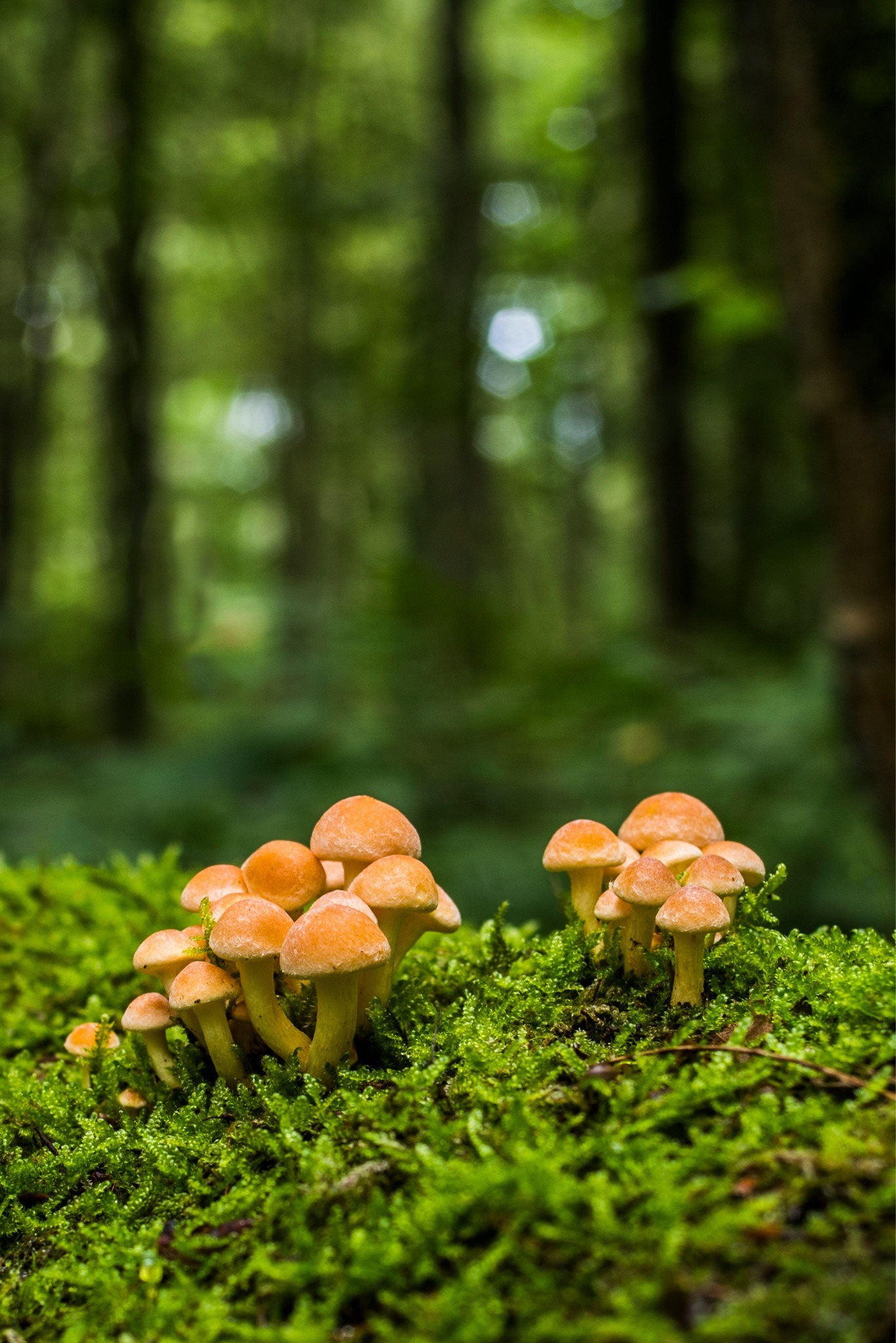
Physical Characteristics
Convex to flattened cap with a sulfur-yellow to orange-brown center, greenish-yellow gills that darken to purple-brown with age, and a slender, crowded growth habit.
Habitat & Growing Conditions
Grows in dense clusters on decaying wood of both broadleaf and coniferous trees.
Season & Fruiting Time
Typically found from spring through late autumn, or even early winter in milder climates.
Similar Looking Species
Hypholoma capnoides (lacks green gill tint), Hypholoma lateritium (brick-red cap), Armillaria species (white spore print, distinct ring).
Ecological Role
Saprophytic; it plays an important role in breaking down dead wood in forest ecosystems.
Fruiting Body
Cap is 2-6 cm wide, smooth, yellowish with a darker center. Gills are crowded, initially sulfur-yellow then becoming olive-green and finally brownish. Stipe is 5-10 cm long, sulfur-yellow, often curved, and lacks a permanent ring but may have a faint veil zone.
Size
Cap diameter 2-6 cm; stipe 5-10 cm long and 0.3-1 cm thick.
Spore Print
Purple-brown
Distribution
Widely distributed across Europe and North America; one of the most common woodland fungi.
Identification Tips
Look for the characteristic sulfur-yellow color and the diagnostic greenish tint in the gills. It almost always grows in tight clusters (tufts) on wood.
Interesting Facts
This fungus contains several bioactive compounds including fasciculols. It is highly resistant to many fungal diseases and is sometimes studied for its ability to compete with wood-rotting pathogens like honey mushrooms.
Safety reminder
AI mushroom identification is a best-effort estimate and can be wrong. Never use it to decide whether a mushroom is safe to handle or eat — always confirm with a qualified mycologist before any consumption.
Identified on: 4/18/2026
Mode: Standard