Possibly a species of Pluteus or a related genus
Pluteus (possible)
Type: gilled mushroom
Physical Characteristics
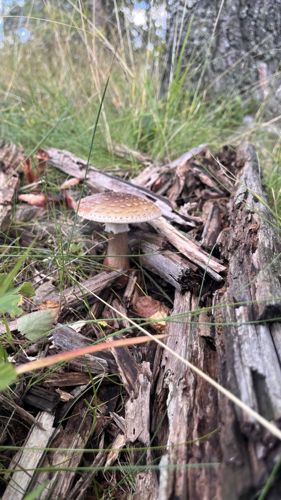
The mushroom in the image appears to have a brownish, somewhat flattened cap, covered with darker scales or speckles. The texture seems to be finely textured or velvety. The gills are not clearly visible, but the underside suggests gilled structure. The stem is visible and of moderate thickness, appearing cylindrical.
Habitat & Growing Conditions
The mushroom is growing on or alongside decaying wood debris, possibly a fallen log or wood chips, in a grassy or wooded area. This suggests a saprobic habitat.
Season & Fruiting Time
Mushrooms growing on wood can vary in season depending on species and climate, but many wood-decaying fungi are found from late spring through autumn, given sufficient moisture.
Similar Looking Species
Without a clear view of the gills, volva, or ring, it is difficult to distinguish from other brown-capped, scaly mushrooms, such as some species of Pholiota or even certain Agaricus species. However, its growth on wood significantly narrows down the possibilities. Members of Pluteus often grow on wood and have free gills. Pholiota species typically have scales on their cap and stipe and often grow on wood, but usually have attached gills and may have a ring. A clear view of gill attachment and spore print color would be crucial for a more precise identification.
Ecological Role
Likely saprobic, growing on decaying wood or woody debris. Saprobic fungi play a crucial role in nutrient cycling by breaking down dead organic matter, returning essential nutrients to the ecosystem for use by other organisms.
Safety reminder
AI mushroom identification is a best-effort estimate and can be wrong. Never use it to decide whether a mushroom is safe to handle or eat — always confirm with a qualified mycologist before any consumption.
Identified on: 7/30/2025
Mode: Standard