Honey Mushroom
Armillaria mellea (sensu lato)
Type: gilled mushroom
Physical Characteristics
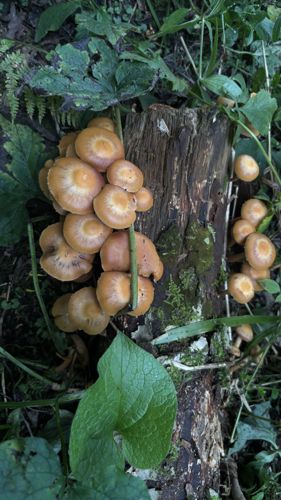
The caps are typically convex to flattened, often with a slight umbo (a central raised part). They are viscous or slimy when wet, especially when young, and their color can range from honey-yellow to darker brown, often fading towards the margin. Gills are typically adnate to decurrent, whitish to yellowish, becoming rusty brown with age due to spore development. The stipe (stem) is central, often tapering towards the base, and can be ringed (annulate) or not, depending on the species and age. Spore print is white to creamy.
Habitat & Growing Conditions
Found growing in clusters on stumps, logs, and at the base of living deciduous and coniferous trees. They are common in woodlands, forests, parks, and disturbed areas where wood is present.
Season & Fruiting Time
Late summer to late autumn, often fruiting after significant rainfall.
Similar Looking Species
Several species of Armillaria exist, which are often grouped under the common name 'Honey Mushroom' (Armillaria mellea complex). Distinguishing them often requires microscopic examination or molecular analysis. Other look-alikes include Galerina marginata (deadly galerina) which has a brown spore print and grows on wood, and Pholiota species, which often have brownish gills and sticky caps but differ in spore color and microscopic features. Careful identification is crucial due to the presence of poisonous look-alikes.
Ecological Role
Armillaria species are primarily parasitic on living trees, causing white rot of wood, which leads to significant damage and death of host trees. They can also grow as saprophytes on dead wood, playing a role in the decomposition of woody debris in forest ecosystems. Their extensive rhizomorphs (root-like structures) allow them to spread widely underground.
Safety reminder
AI mushroom identification is a best-effort estimate and can be wrong. Never use it to decide whether a mushroom is safe to handle or eat — always confirm with a qualified mycologist before any consumption.
Identified on: 7/29/2025
Mode: Standard