Bay Bolete
Imleria badia (formerly Xerocomus badius or Boletus badius)
Type: bolete
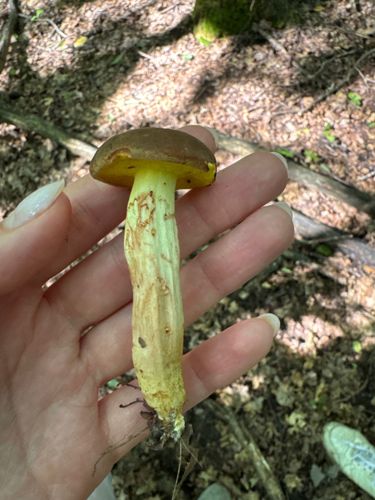
Physical Characteristics
Cap is typically convex to broadly convex, brown to olive-brown. The underside of the cap has pores instead of gills, which are typically yellow and may stain blue when bruised. The stem is generally stout, yellowish, often with reticulation (a net-like pattern) or striations, and can stain blue or greenish when handled. Spore print is olive-brown.
Habitat & Growing Conditions
Found on the ground in deciduous and coniferous forests, often associated with oak, pine, or fir trees. Prefers well-drained soil.
Season & Fruiting Time
Late summer to late autumn, especially after periods of rain.
Similar Looking Species
There are several boletes that can look similar. The Chestnut Bolete (Gyroporus castaneus) has a more uniformly brown cap and stem, and its pores do not stain blue. Other boletes in the Xerocomellus genus might resemble it, but differ in pore color, staining reactions, or cap texture.
Ecological Role
Mycorrhizal, forming a symbiotic relationship with the roots of various trees, particularly beneficial for nutrient exchange between the fungi and the tree.
Safety reminder
AI mushroom identification is a best-effort estimate and can be wrong. Never use it to decide whether a mushroom is safe to handle or eat — always confirm with a qualified mycologist before any consumption.
Identified on: 7/31/2025
Mode: Standard