Sulphur Tuft
Hypholoma fasciculare
Type: gilled mushroom
Physical Characteristics
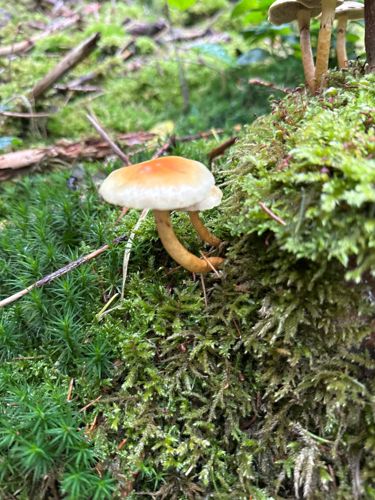
Caps are typically 2-7 cm in diameter, yellowish to orange-brown, often with a darker center, and may have a greenish tinge. They are convex to flat, sometimes with a slight umbo, and have a smooth margin. Gills are crowded, adnate to adnexed, starting yellowish and becoming greenish-grey to purplish-brown with age. Stems are usually 3-10 cm long and 0.4-1 cm thick, yellowish, darker towards the base, often curved, and may have a faint, ephemeral ring zone. Spore print is purplish-brown.
Habitat & Growing Conditions
Grows in dense clusters on dead wood, conifers, and hardwoods, often on stumps, logs, and buried wood. It can be found in forests, woodlands, and even parks.
Season & Fruiting Time
Common from late spring through autumn, sometimes into early winter in milder climates.
Similar Looking Species
Similar species include Galerina marginata (deadly poisonous, has a distinct ring and rusty brown spore print), Hypholoma capnoides (gills are greyish to pallid, never green), and Pholiota species. The greenish tint of the gills in mature specimens of Hypholoma fasciculare is a good distinguishing feature.
Ecological Role
Sulphur Tuft is a saprophytic fungus, meaning it plays a crucial role as a decomposer of dead wood in forest ecosystems. It breaks down cellulose and lignin, returning nutrients to the soil and contributing to nutrient cycling.
Safety reminder
AI mushroom identification is a best-effort estimate and can be wrong. Never use it to decide whether a mushroom is safe to handle or eat — always confirm with a qualified mycologist before any consumption.
Identified on: 10/25/2025
Mode: Standard