Porcini / Penny Bun
Boletus edulis
Type: bolete
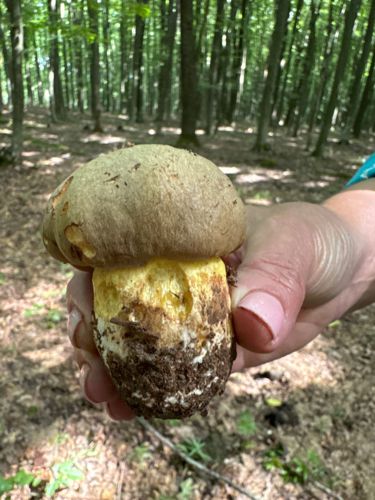
Physical Characteristics
This mushroom has a robust, convex cap, typically light brown to yellowish-brown. The underside of the cap features a sponge-like pore surface that is yellowish, appearing to bruise blue when handled or damaged. The stem is stout and bulbous, often showing reticulation (a net-like pattern) and discoloration, commonly yellow at the top and brownish towards the base, with some dirt adhering to the base. The flesh is firm.
Habitat & Growing Conditions
Porcini (Boletus edulis) typically grow on the ground in woodlands and forests, particularly under conifers (like spruce, pine, and fir) and broadleaf trees (like oak, beech, and birch). They prefer well-drained, acidic to neutral soils and are often found in mossy areas or among leaf litter.
Season & Fruiting Time
Porcini are typically found from late summer through autumn, depending on the region and weather conditions. They fruit after periods of rain, followed by warm, humid weather.
Similar Looking Species
Several bolete species can be confused with Boletus edulis. Key look-alikes include Tylopilus felleus (Bitter Bolete), which has pinkish pores and very bitter taste, and various species of Leccinum (Scaber Stalks), which typically have scabers (dark dots or lines) on their stems and often specific tree associations. Other edible Boletes like Boletus aereus (Bronze Bolete) and Boletus reticulatus (Summer Bolete) are also very similar but have slightly different cap colors or growing seasons.
Ecological Role
Porcini mushrooms are mycorrhizal, forming a symbiotic relationship with the roots of certain trees. They help their host trees absorb nutrients and water from the soil, while receiving sugars produced by the tree through photosynthesis. This symbiotic relationship is crucial for the health and growth of both the fungus and the trees in forest ecosystems.
Safety reminder
AI mushroom identification is a best-effort estimate and can be wrong. Never use it to decide whether a mushroom is safe to handle or eat — always confirm with a qualified mycologist before any consumption.
Identified on: 7/31/2025
Mode: Standard