Bird's Nest Fungi (Pouch Type)
Calocera cornea
Type: Cup Fungus
Physical Characteristics
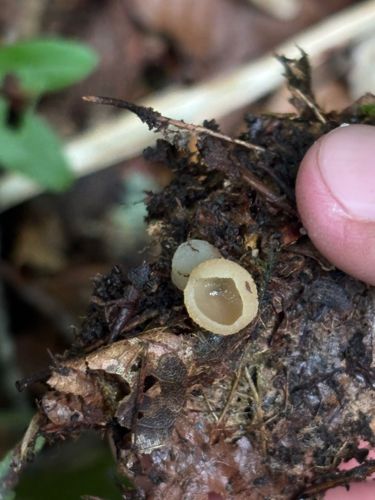
The fruit bodies are small, typically 2-5 mm in diameter, and have a cup-like or shallow saucer shape. They are often translucent to light yellowish-brown, sometimes nearly white, with a smooth to slightly granular outer surface. The inner fertile surface (hymenium) is typically smooth and slightly paler. Often found in clusters.
Habitat & Growing Conditions
Typically found growing on decaying plant material, such as rotting wood, leaves, twigs, and other forest debris. It prefers damp, shady conditions in forests and woodlands.
Season & Fruiting Time
Generally found from spring through autumn, and sometimes into early winter in milder climates, particularly after periods of rain.
Similar Looking Species
Some small discomycetes (cup fungi) might look superficially similar, but 'Bird's Nest Fungi' (even the pouch types) are distinct in their structure. For *Calocera cornea*, it could be confused with other small, jelly-like fungi, but its distinctive horn-like or branched shape (though not always evident in very young or damaged specimens) and brighter yellow to orange color are differentiating features. The image appears to show a cup fungus, possibly a species of *Cudoniella* or *Hymenoscyphus*, which are small, pale cup fungi commonly found on decaying wood or plant debris in damp environments. Without clearer details of the structure and context, a definitive species identification is challenging. However, the initial impression of a small, pale cup is consistent with these genera. The initial thought of Nidulariaceae (Bird's Nest Fungi) is incorrect as these have 'eggs' inside the cup, which are absent here. The more likely identification visually aligns with a small, pale cup fungus.
Ecological Role
This species is saprophytic, meaning it obtains nutrients by decomposing dead organic matter, primarily plant debris such as leaves, twigs, and other forest litter. It plays an important role in nutrient cycling in its ecosystem, breaking down complex organic compounds and returning nutrients to the soil.
Safety reminder
AI mushroom identification is a best-effort estimate and can be wrong. Never use it to decide whether a mushroom is safe to handle or eat — always confirm with a qualified mycologist before any consumption.
Identified on: 7/29/2025
Mode: Standard