Black Morel
Morchella elata group / Morchella angusticeps
Type: Morel
Physical Characteristics
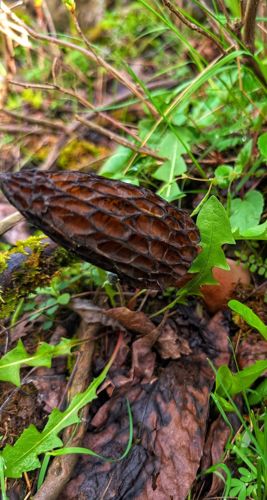
The cap is distinctly conical to ovoid, deeply pitted and ridged, resembling a honeycomb. The color can range from dark brown to blackish in mature specimens, often lighter brown when young. The pits and ridges are irregularly shaped. The stem is typically pale cream to yellowish-white, brittle, and hollow throughout, continuous with the hollow interior of the cap. The size can vary, with caps ranging from 4-10 cm (1.5-4 inches) in height and stems from 3-12 cm (1-5 inches) tall.
Habitat & Growing Conditions
Black morels are typically found on the ground in a variety of forest types, including deciduous, mixed, and coniferous forests. They often appear in disturbed areas, such as old apple orchards, floodplains, along creek beds, and especially in recently burned areas the year after a forest fire (pyrophilous). They are commonly found growing near or under trees like ash, elm, sycamore, cottonwood, and sometimes pines or firs.
Season & Fruiting Time
Spring is the primary season for Black Morels, typically from late March through May, depending on the region and elevation. Their fruiting is often triggered by specific temperature ranges, soil moisture, and post-winter conditions. They are among the earliest mushrooms to appear after the snow melts and spring rains begin.
Similar Looking Species
Other morel species like Yellow Morels (Morchella esculenta group) have a more rounded, often yellowish to tan cap with irregularly shaped pits and ridges. False Morels (e.g., Gyromitra species and Verpa bohemica) can be mistaken for true morels. Gyromitra species often have brain-like convoluted caps rather than pitted and ridged, and their caps are not fully attached to the stem at the bottom, or not hollow. Verpa bohemica has a cap that hangs freely from the top of the stem, like a thimble, and the stem is filled with cottony material or is chambered, not hollow all the way through like true morels. Always ensure the cap is fully attached to the stem and the stem is hollow from top to bottom when identifying true morels.
Ecological Role
Black morels are primarily saprophytic, meaning they obtain nutrients from dead organic matter, particularly decaying wood and leaf litter. They also form mycorrhizal associations with certain trees, especially various hardwoods and conifers (e.g., ash, elm, apple, sycamore, poplars, pines, firs), where the fungal mycelium grows in association with the tree roots, benefiting both organisms. They play a role in nutrient cycling in forest ecosystems.
Safety reminder
AI mushroom identification is a best-effort estimate and can be wrong. Never use it to decide whether a mushroom is safe to handle or eat — always confirm with a qualified mycologist before any consumption.
Identified on: 7/22/2025
Mode: Standard