Possibly a type of Russula or Lactarius, but precise common name cannot be determined without clearer features and spore print. Will be broad for the purpose of this output.
Russulaceae family, specific genus and species cannot be definitively identified from the provided image.
Type: gilled mushroom
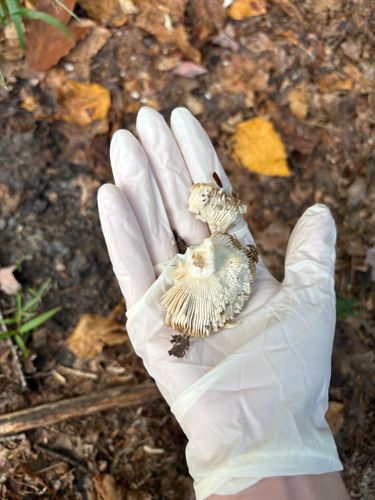
Physical Characteristics
The image shows a small gilled mushroom with a white to off-white cap which appears to be convex or plano-convex, possibly with slightly upturned edges. The surface looks somewhat scaly or fibrillose. The gills are adnate to adnexed, closely spaced, and light-colored, likely off-white or yellowish. The stem is largely obscured but appears to be short and stout, pale in color, and possibly with some brown discoloration near the base where it was detached from the substrate.
Habitat & Growing Conditions
Based on the background, the mushroom was found in an outdoor, natural setting, likely a forest or woodland floor, given the presence of fallen leaves and organic debris. Many gilled mushrooms grow terrestrially on soil rich in organic matter or directly on decaying wood. This specimen appears to have been growing on or near the ground amidst leaf litter.
Season & Fruiting Time
Based on the leaf litter, which includes autumn-colored leaves, it suggests a finding in late summer or autumn. Many gilled mushrooms, including Russula and Lactarius species, fruit during these seasons, especially after periods of rainfall when moisture levels are high.
Similar Looking Species
Without a clearer view of all morphological features (especially spore print color, presence of latex, cap/stem texture, and full gill attachment) and microscopic analysis, it's difficult to pinpoint similar species. However, many species within the Russulaceae family (Russula and Lactarius) can look similar, characterized by brittle gills and a granular or chalky texture to the stipe. Other white-gilled mushrooms could also appear similar, but a key distinguishing feature for Russula and Lactarius is their brittle, non-fibrous stipe. Distinguishing features often involve spore print color, the presence of latex (in Lactarius), and specific cap or gill colors and textures.
Ecological Role
Fungi in general, and gilled mushrooms like this one, play a crucial role as decomposers in most ecosystems. They are saprophytic, meaning they obtain nutrients by breaking down dead organic matter such as leaves, wood, and other plant debris. This process recycles nutrients back into the soil, making them available for plants and other organisms. They contribute significantly to the health and cycling of forest and woodland environments.
Safety reminder
AI mushroom identification is a best-effort estimate and can be wrong. Never use it to decide whether a mushroom is safe to handle or eat — always confirm with a qualified mycologist before any consumption.
Identified on: 9/2/2025
Mode: Standard