Bicolor Bolete
Baorangia bicolor
Type: Bolete mushroom
Physical Characteristics
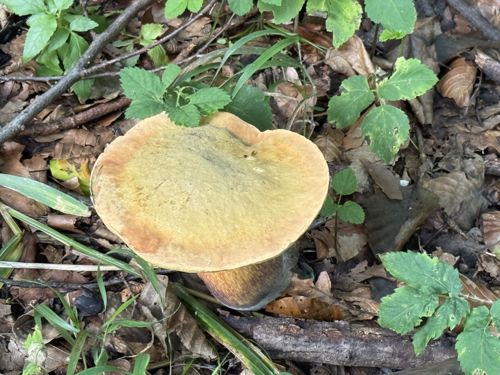
Cap: Typically 5-15 cm in diameter, convex to broadly convex or nearly flat in age. Color is usually rose red to brick red, often fading to a duller reddish-brown or yellowish-red with age or in dry conditions. The surface is dry and velvety or finely tomentose. Pore surface: Bright yellow when young, becoming olive-yellow with age. Pores are small (2-3 per mm) and circular to angular. They usually stain blue instantly when bruised. Stem: 5-12 cm long and 1-3.5 cm thick, solid, often tapered towards the apex or base, or equal. Color is usually yellow at the apex, becoming red towards the base, though it can be entirely yellow or red. It is typically dry and lacks a ring. Flesh: Pale yellow in the cap and upper part of the stem, often red in the lower stem. Stains blue when cut, though the intensity of the blue staining can vary. Spore print: Olive-brown.
Habitat & Growing Conditions
Mycorrhizal with hardwoods, especially oak. Found growing solitarily or scattered on the ground in deciduous and mixed woods.
Season & Fruiting Time
Summer and early autumn (June to October).
Similar Looking Species
Similar species include other red-capped boletes. It can be distinguished from some by the blue staining of its pores and flesh, though the intensity of staining varies. For example, Boletus sensibilis also stains blue but often more intensely and rapidly. Boletus subvelutipes has a red stem base with a reticulate (net-like) pattern and typically stains blue more intensely. Baorangia palmerana is similar but typically has a more orange-red cap. Always consult an experienced mycologist for positive identification.
Ecological Role
Mycorrhizal, forming a symbiotic relationship with hardwood trees. The fungus extends its mycelial network into the soil, increasing the tree's ability to absorb water and nutrients, while the tree provides the fungus with carbohydrates produced through photosynthesis.
Safety reminder
AI mushroom identification is a best-effort estimate and can be wrong. Never use it to decide whether a mushroom is safe to handle or eat — always confirm with a qualified mycologist before any consumption.
Identified on: 9/14/2025
Mode: Standard