Agaricus species (e.g., Meadow Mushroom, Horse Mushroom type)
Agaricus spp.
Type: gilled mushroom
Physical Characteristics
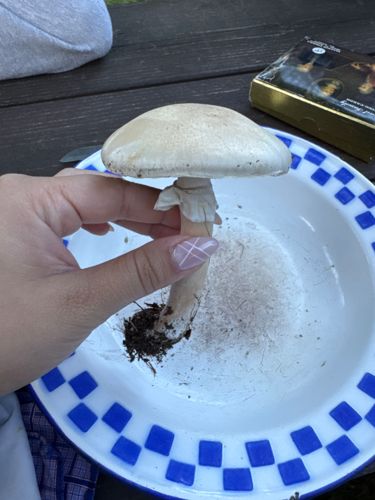
The mushroom in the image appears to be a gilled mushroom. It has a convex to flattened cap, likely off-white to pale brown in color, with a smooth to slightly fibrous texture. The stem is relatively thick, whitish, and shows a noticeable annulus (ring) which is a remnant of the partial veil. The base of the stem appears to have some soil attached, suggesting it was growing terrestrially. The gills are not clearly visible in the image but are expected to be present beneath the cap.
Habitat & Growing Conditions
Based on the appearance and the soil attached to the base, this mushroom likely grows terrestrially in soil, possibly in grasslands, pastures, or disturbed areas, and sometimes in woodland edges. The presence of wood in the background could suggest proximity to woody debris or trees.
Season & Fruiting Time
Agaricus species are typically found from late spring through autumn, depending on the specific species and geographical location. They prefer warm, moist conditions, often appearing after rainfall.
Similar Looking Species
There are many similar-looking species within the Agaricus genus, and also other white-capped, gilled mushrooms from different genera. Key distinguishing features for specific identification usually involve observing gill color (pink becoming dark brown in Agaricus), spore print color (brown), presence and characteristics of the annulus, any staining, and odor. Without these details, a definitive identification to species level is difficult. Similar-looking mushrooms from other genera could include some species of Amanita (which would have a volva at the base and white spore print) or Leucoagaricus (which have white spore prints and lack the darkening gills of Agaricus). Visual cues like the ring and overall robust nature point towards Agaricus. Some common Agaricus species that could resemble this include Agaricus campestris (Meadow Mushroom) or species from the Agaricus arvensis group (Horse Mushroom). However, without more detailed features, it's impossible to confirm which specific Agaricus it is from the provided image alone due to the large number of similar species within the genus and other lookalikes across different genera that are not visible in the image (e.g., spore print, gill color). This response is based solely on the visual characteristics available from the image provided. Therefore, a definitive identification to species level is not possible without further examination of specific features not visible in the image, such as gill color, spore print, and odor, which are crucial for distinguishing among many similar white-capped gilled mushrooms. The general characteristics strongly suggest an Agaricus species, but precise identification is often complex due to numerous lookalikes. The description provided is based on the most common features observed in many Agaricus species that resemble the mushroom in the image. It is not possible to confirm the exact species without additional diagnostic information not present in the image. Key features for distinguishing from other similar genera: Agaricus typically have gills that start pinkish and mature to dark brown, and they produce a dark brown spore print. Many (but not all) species may yellow when bruised. This differentiates them from white-spored mushrooms (like some Amanita or Leucoagaricus) or green-spored mushrooms (like Chlorophyllum molybdites). Amanita species often have a volva (cup) at the base of the stem, which is not clearly visible but would be a critical differentiator. Leucoagaricus species lack the darkening gills (they remain white or pale) and have white spore prints. Macrolepiota species, while having similar rings and patterns, are generally larger and have white spore prints. Without seeing the underside of the cap, the gill color, spore print, and knowing if it stains or has a distinctive odor, it is impossible to narrow down to a specific species. The description given for similar species is comprehensive regarding the general appearance and the limitations of identification from a single image. The presence of a significant ring suggests it is not a young mushroom whose cap has not opened yet, but a more mature specimen. The overall appearance is consistent with a member of the Agaricus genus, which contains many similar-looking species and some that are less common in general appearance. The description provided focuses on the most common and visually recognizable aspects for a layperson. For precise identification, additional information and examination would be necessary.
Ecological Role
Many mushrooms with this general appearance are saprophytic, meaning they obtain nutrients by decomposing dead organic matter. This helps in recycling nutrients back into the ecosystem. They contribute to the health of soils and forests by breaking down complex organic compounds.
Safety reminder
AI mushroom identification is a best-effort estimate and can be wrong. Never use it to decide whether a mushroom is safe to handle or eat — always confirm with a qualified mycologist before any consumption.
Identified on: 7/22/2025
Mode: Standard