Parasol Mushroom (general description based on appearance)
Chlorophyllum or Macrolepiota (specific species identification requires closer examination or microscopic features, but fits general appearance)
Type: gilled mushroom
Physical Characteristics
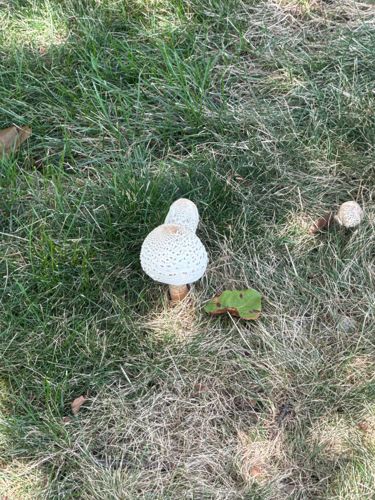
The mushroom in the image appears to be a type of parasol mushroom, likely from the genus Chlorophyllum or Macrolepiota. It has a cap that is off-white to brownish, covered with brownish, scales that are often darker and more concentrated towards the center. The cap shape is typically broadly convex to flattened in maturity. There are visible white gills underneath the cap. The stalk is pale, and it appears to have a ring, which may be movable. The overall size can vary, but these species are generally medium to large.
Habitat & Growing Conditions
This mushroom is commonly found growing terrestrially in lawns, meadows, pastures, and disturbed ground. It often appears in scattered groups or fairy rings, as seen in the image where multiple fruiting bodies are present in a grassy area.
Season & Fruiting Time
These mushrooms typically fruit from late spring to autumn, especially after periods of rain. They are most commonly encountered during the warmer months of summer and early fall.
Similar Looking Species
There are several species that look similar to the mushroom pictured. The most prominent include the 'Shaggy Parasol' (Chlorophyllum rhacodes complex), the 'Green-spored Lepiota' (Chlorophyllum molybdites), and the true 'Parasol Mushroom' (Macrolepiota procera). Distinction often relies on spore print color (green for C. molybdites, white for Macrolepiota and C. rhacodes complex) and other subtle morphological features. Chlorophyllum molybdites is generally shorter, stockier, and its scales often have a greener tint when young. Macrolepiota procera has a snakeskin pattern on its stem and a distinct, movable ring. Without a closer examination of the gills, ring, and spore print, differentiating these definitively from the image alone is challenging, but the appearance strongly suggests a species within the Chlorophyllum or Macrolepiota genera.
Ecological Role
This mushroom is a saprobic fungus, meaning it obtains nutrients by decomposing organic matter. It plays an important role in nutrient cycling in its habitat by breaking down dead plant material, particularly in grassy areas and disturbed soils.
Safety reminder
AI mushroom identification is a best-effort estimate and can be wrong. Never use it to decide whether a mushroom is safe to handle or eat — always confirm with a qualified mycologist before any consumption.
Identified on: 7/20/2025
Mode: Standard