Wood Ear
Auricularia auricula-judae or similar Auricularia species
Type: Cup fungus
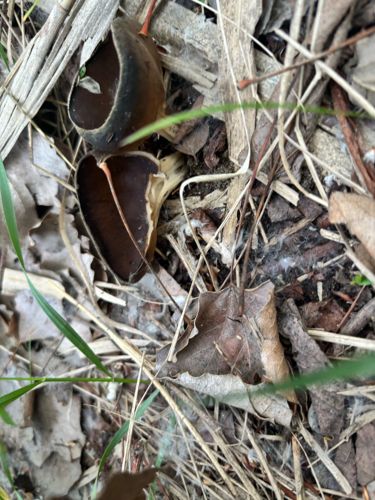
Physical Characteristics
Cup-shaped to ear-shaped or spathulate (spoon-shaped) brownish fruitbodies, typically with a somewhat gelatinous or leathery texture. The inner surface (hymenium) is darker brown to blackish, smooth, and spore-bearing. The outer surface is often paler, sometimes with fine hairs. They can be sessile (attached directly) or have a short, rudimentary stem. The ones in the image appear to be small, dark, and somewhat ear-shaped, growing on the ground among leaf litter.
Habitat & Growing Conditions
Typically grows on dead hardwood or conifer wood, often buried or partially buried, but can also appear to be growing directly on soil rich in woody debris or leaf litter. They prefer damp conditions in forests or woodlands.
Season & Fruiting Time
Found year-round in many climates, especially after wet periods, but most commonly in late autumn, winter, and early spring when other fungi are less abundant. They can tolerate cold weather and are often encountered when temperatures are cool.
Similar Looking Species
Other species within the genus Auricularia, such as Auricularia mesenterica (which is more disc-shaped and hairy) or other gelatinous fungi. Distinguishing features often involve examining the texture, color, and habitat precisely. Another similar species is Auricularia cornea, which typically grows on wood and is often paler and more cup-shaped.
Ecological Role
Saprotrophic, decomposing dead organic matter such as wood debris, leaf litter, and other plant material. They play a crucial role in nutrient cycling in forest ecosystems, breaking down complex organic compounds and returning nutrients to the soil.
Safety reminder
AI mushroom identification is a best-effort estimate and can be wrong. Never use it to decide whether a mushroom is safe to handle or eat — always confirm with a qualified mycologist before any consumption.
Identified on: 7/22/2025
Mode: Standard