Red-belted Conk
Fomitopsis pinicola
Type: Polypore
Physical Characteristics
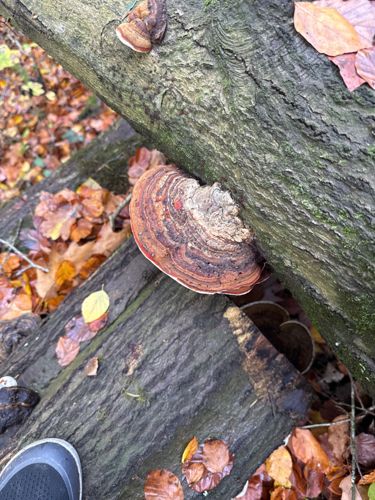
The Red-belted Conk is a large, hoof-shaped to fan-shaped polypore. The cap, which can grow up to 30 cm across, features concentric bands of color, typically with reddish, orange, brown, and greyish zones. A distinctive feature is often a reddish or orange band near the margin in younger or active growth stages. The surface is smooth and often varnished or resinous, especially when young, becoming duller with age. The underside of the fruiting body is white or cream-colored, with a fine pore surface. The flesh is tough and corky, pale cream to yellowish-brown.
Habitat & Growing Conditions
This fungus is common on dead conifers and hardwoods, especially logs and stumps, but can also be found on living trees where it acts as a weak parasite. It causes a brown rot.
Season & Fruiting Time
It is a perennial fungus, meaning its fruiting bodies can persist for several years, growing larger each year. Spore production typically occurs from spring through late autumn, but the conks can be observed year-round.
Similar Looking Species
Similar species include other large bracket fungi. Ganoderma applanatum (Artist's Conk) has a duller, often greyish-brown to black upper surface and bruises dark brown on the pore surface. Trametes versicolor (Turkey Tail) is much smaller and thinner. Phellinus igniarius is uniformly dark and typically more hoof-shaped without the distinct colorful banding.
Ecological Role
Fomitopsis pinicola is a significant white-rot fungus (though it causes brown rot, confusingly enough) and functions primarily as a saprophyte, decomposing dead wood and returning nutrients to the ecosystem. It can also act as a weak parasite on stressed or wounded living trees, particularly conifers, contributing to their eventual decay. Its persistent fruiting bodies provide habitat for various insects.
Safety reminder
AI mushroom identification is a best-effort estimate and can be wrong. Never use it to decide whether a mushroom is safe to handle or eat — always confirm with a qualified mycologist before any consumption.
Identified on: 10/25/2025
Mode: Standard