Orange Gilled Mushroom (General Appearance)
Unidentifiable beyond general characteristics from image alone
Type: gilled mushroom
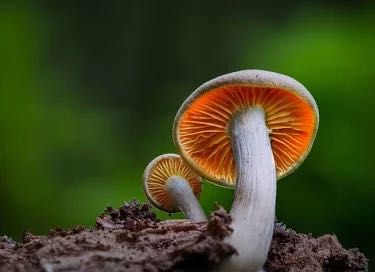
Physical Characteristics
The image displays two gilled mushrooms. The larger one has a convex cap, light in color, possibly off-white or light brown, with an impressive orange-red hue on the underside, illuminating the prominent gills. The gills are radiating from the center and appear crowded. The stem (stipe) is central, relatively thick, and lighter in color, possibly white or cream. The smaller mushroom in the foreground shares similar characteristics but is less developed.
Habitat & Growing Conditions
The mushrooms are growing directly out of what appears to be soil or decomposed organic matter. Many gilled mushrooms grow on the ground in forests, woodlands, or disturbed areas, often associated with specific types of trees or decaying wood.
Season & Fruiting Time
The fruiting season for gilled mushrooms varies widely depending on the specific species and geographical location. However, many species typically fruit during periods of high humidity and moderate temperatures, such as late summer and autumn.
Similar Looking Species
Without more specific features such as spore print, microscopic details, or a clearer view of the cap and stem texture, it is difficult to confidently identify a definitive species or specific similar-looking species. Many gilled mushrooms have orange or reddish gills, including various species within genera such as Laccaria, Hygrocybe, and others. Distinguishing features often involve cap shape and color variations, stem characteristics (e.g., presence of a ring, texture), gill attachment, and spore print color, which are not discernible from this image.
Ecological Role
Fungi play crucial roles in ecosystems as decomposers, breaking down organic matter and recycling nutrients. Many gilled mushrooms, like the one pictured, are saprophytic, obtaining nutrients from dead organic material, such as wood or leaf litter. Others can be mycorrhizal, forming symbiotic relationships with plant roots, aiding in nutrient absorption for the plant, and receiving carbohydrates in return.
Safety reminder
AI mushroom identification is a best-effort estimate and can be wrong. Never use it to decide whether a mushroom is safe to handle or eat — always confirm with a qualified mycologist before any consumption.
Identified on: 7/23/2025
Mode: Standard