Cluster Poplar Mushroom
Pholiota destruens
Type: gilled mushroom
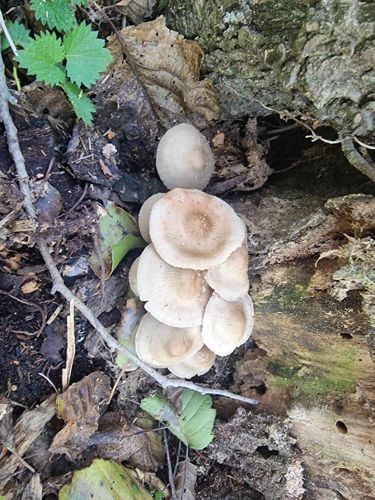
Physical Characteristics
The Cluster Poplar Mushroom has a cap that starts convex and flattens with age, often with a broad umbo. It is typically a pale yellowish-brown to white, covered with large, coarse, woolly scales, especially when young, which may become flattened or disappear with age. The gills are adnate to adnexed, close, and whitish to pale yellow, becoming rusty brown due to spore maturity. The stem is solid, central or slightly eccentric, whitish to brownish, and often has a scaly surface or remnants of a partial veil forming a ring which can be indistinct. The spore print is rusty brown. The size of the cap can range from 5 to 20 cm in diameter, and the stem can be 5 to 15 cm long and 1 to 3 cm thick.
Habitat & Growing Conditions
This mushroom is a saprobic species, growing in clusters or sometimes solitarily on dead or decaying hardwood, particularly poplar (Populus species) and sometimes willow. It is also known to grow on living trees as a weak parasite, causing a white rot.
Season & Fruiting Time
It is typically found from late summer through autumn.
Similar Looking Species
Other species of Pholiota can look similar. Pholiota squarrosa (Shaggy Scalycap) is another scaly Pholiota but typically has more prominent, recurved scales on the cap and stem and is often found on a broader range of deciduous and coniferous wood.
Ecological Role
Pholiota destruens is a saprobic fungus, playing an important role in the decomposition of dead hardwood, especially poplar and willow, returning nutrients to the ecosystem. It can also act as a weak parasite on living trees, contributing to their decay over time, causing a white rot.
Safety reminder
AI mushroom identification is a best-effort estimate and can be wrong. Never use it to decide whether a mushroom is safe to handle or eat — always confirm with a qualified mycologist before any consumption.
Identified on: 11/3/2025
Mode: Standard