Common Puffball, Warted Puffball
Lycoperdon perlatum
Type: Puffball
Physical Characteristics
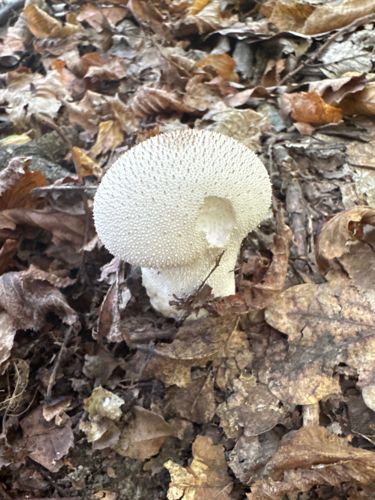
The fruit body is typically pear-shaped or top-shaped, 3-7 cm tall, and 2-5 cm wide. It is whitish to pale brown and covered with short, cone-shaped, detachable spines that leave small, net-like scars when they fall off. The base is often stalk-like and wrinkled. Internally, the gleba (spore-bearing tissue) is white and firm when young, turning olive-brown and powdery as it matures and spores are produced. There are no gills.
Habitat & Growing Conditions
This mushroom is saprophytic, growing on decaying organic matter in woodlands, forests, and grassy areas. It can be found singly or in groups, often on the ground among leaf litter, on rotting wood, or in disturbed soil.
Season & Fruiting Time
Commonly found from late summer through autumn, and sometimes into early winter in milder climates.
Similar Looking Species
Other puffball species. The common puffball can be distinguished from some similar species by its distinctive spiny surface which leaves a net-like pattern when the spines are rubbed off. Some species of 'earthballs' (Scleroderma) also have a thick, leathery outer skin and dark purplish-black gleba, differing from the white gleba of young Lycoperdon perlatum.
Ecological Role
Lycoperdon perlatum is a saprobic fungus, meaning it obtains nutrients by breaking down dead organic matter. It plays a crucial role in decomposition, recycling nutrients back into the ecosystem, which is vital for maintaining healthy forests and other terrestrial habitats.
Safety reminder
AI mushroom identification is a best-effort estimate and can be wrong. Never use it to decide whether a mushroom is safe to handle or eat — always confirm with a qualified mycologist before any consumption.
Identified on: 9/21/2025
Mode: Standard