Chanterelle
Cantharellus lateritius
Type: gilled mushroom
Physical Characteristics
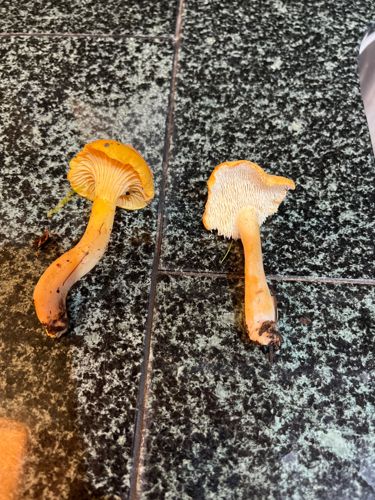
The Smooth Chanterelle has a cap that is typically yellow to orange, often depressed or funnel-shaped when mature, with a wavy margin. Unlike many gilled mushrooms, it has blunt, fold-like ridges (veins) on the underside of its cap that are often forking and cross-veined, rather than true gills, or are nearly smooth to slightly wrinkled. These folds are the same color as the cap or slightly lighter. The stem is solid, tapering towards the base, and also yellow to orange. The flesh is firm and white to pale yellow. This variety often lacks the strong fruity aroma associated with C. cibarius, though some can have a slight peppery or spicy scent. The spore print is typically pale yellow to creamy white.
Habitat & Growing Conditions
This mushroom is typically found growing scattered or in groups on the ground in deciduous and mixed forests. It often forms mycorrhizal associations with hardwood trees, especially oaks, though it can also be found with conifers. It prefers rich, well-drained soil.
Season & Fruiting Time
It is typically found in summer and early autumn, especially after periods of rain.
Similar Looking Species
Similar looking species include other Chanterelles such as Cantharellus cibarius (Golden Chanterelle) which has more prominent, often decurrent, blunt gill-like ridges, and Craterellus species (Trumpet Chanterelles/Black Trumpets) which are generally darker and have smooth or wrinkled undersides. The Jack O'Lantern mushroom (Omphalotus illudens) is a toxic look-alike; it grows in dense clusters on wood, has true, sharp, blade-like gills that are brighter orange, and often has bioluminescent properties, distinguishing it from Cantharellus species which grow on the ground and have blunt folds or veins.
Ecological Role
Cantharellus lateritius is a mycorrhizal fungus, forming a symbiotic relationship with the roots of trees, primarily hardwoods like oaks. In this relationship, the fungus helps the tree absorb water and nutrients from the soil, while the tree provides the fungus with carbohydrates produced through photosynthesis. This symbiotic relationship is crucial for the health and growth of the host trees and contributes to the nutrient cycling within the forest ecosystem. It also acts as a decomposer of organic matter, albeit indirectly through its mycorrhizal network, thus enriching the soil quality and promoting biodiversity within its habitat.
Safety reminder
AI mushroom identification is a best-effort estimate and can be wrong. Never use it to decide whether a mushroom is safe to handle or eat — always confirm with a qualified mycologist before any consumption.
Identified on: 11/29/2025
Mode: Standard