Suillus collinitus (Commonly referred to as a "Bolete" species given the visual characteristics)
Suillus collinitus
Type: Bolete
Physical Characteristics
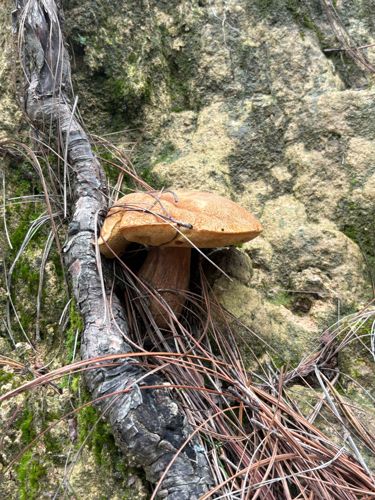
The mushroom in the image appears to be a bolete, characterized by its prominent cap and a spongy layer of tubes (pores) on the underside instead of gills. The cap is a brownish-orange color, broad, and somewhat convex to flattened. The stem is robust and brownish, although its full structure is not entirely visible. The overall form suggests a fleshy mushroom which is typical of boletes.
Habitat & Growing Conditions
Based on the visual evidence, the mushroom is growing terrestrially near the base of what appears to be a tree root or trunk, surrounded by pine needles and what looks like rocky, mossy ground. This is consistent with boletes that often form mycorrhizal associations, specifically with pine trees. Many bolete species prefer coniferous forests.
Season & Fruiting Time
Suillus species, including Suillus collinitus, are typically found fruiting in late summer and autumn, often after periods of rain. Their season can extend into early winter in milder climates. Their emergence is tied to the growing season of their host trees and favorable moisture conditions.
Similar Looking Species
Many species within the genus Suillus, as well as other bolete genera (e.g., Boletus, Leccinum), can look similar, especially in cap color and general shape. Distinguishing features often include the color and texture of the cap (especially if it's slimy or sticky), the color and staining reaction of the pores and flesh, the presence and nature of a ring on the stem, and the specific tree association. For Suillus collinitus, the pinkish-purple mycelial mat at the base of the stem (often covered by substrate) is a key distinguishing feature, though not visible in this image. Other Suillus species, such as Suillus granulatus or Suillus luteus, might have similar cap colors but differ in pore characteristics, stem ornamentation, or viscosity of the cap surface.
Ecological Role
Most boletes, including species like Suillus collinitus, are mycorrhizal, forming symbiotic relationships with the roots of living trees. They help their host trees absorb water and nutrients (especially phosphorus and nitrogen) from the soil, while receiving carbohydrates synthesized by the tree in return. This mutualistic relationship is vital for the health and growth of many forest ecosystems.
Safety reminder
AI mushroom identification is a best-effort estimate and can be wrong. Never use it to decide whether a mushroom is safe to handle or eat — always confirm with a qualified mycologist before any consumption.
Identified on: 8/3/2025
Mode: Standard