
Community find
Bonnet Mushroom
Mycena species
- Group
- Gilled mushroom
- Season
- Many Mycena species can be found from late summer through autumn, and sometimes into early winter in milder climates, particularly after periods of rain.
- Habitat
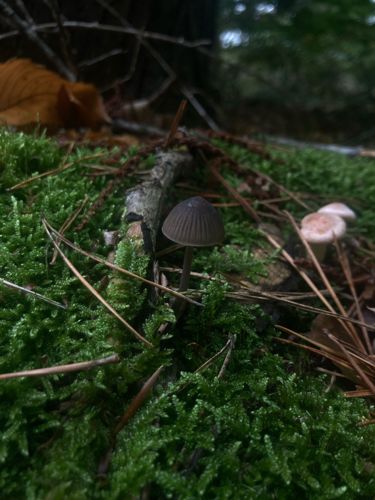
- Mycena species generally grow on decaying wood, leaf litter, or mossy ground in damp, shaded environments, often in coniferous and deciduous forests. The image shows the mushroom growing on mossy ground with pine needles, suggesting a forest habitat.
- Key characteristics
- The visible mushroom has a conical or bell-shaped cap, dark grey to brownish in color, with distinct striations or grooves running from the cap margin towards the center. The stem is slender and appears to be consistent in color with the cap or slightly lighter. The gills are not clearly visible in this image but are typically adnexed or adnate. The overall size is small, consistent with a 'little brown mushroom' (LBM) classification.
- Look-alikes
- There are many species within the genus Mycena, and distinguishing them can be challenging without microscopic examination or more detailed features. Other small, brown, conical mushrooms, such as some species of Galerina or Conocybe, could appear superficially similar, but Mycena species typically have a more delicate structure, and many have distinctive cap striations like those seen. The overall appearance is quite characteristic of the Mycena genus.
- Ecological role
- Mycena species are primarily saprophytic, meaning they obtain nutrients by decomposing dead organic matter, such as wood and plant debris. They play a crucial role in nutrient cycling in forest ecosystems by breaking down complex organic materials and returning nutrients to the soil. This contributes to soil health and supports the growth of other plants and organisms.