Bolete
Boletus (genus)
Type: Bolete
Physical Characteristics
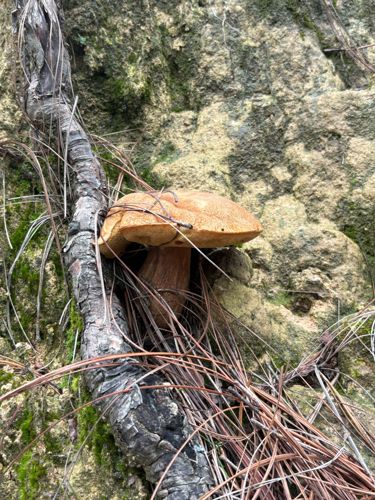
The mushroom in the image appears to be a bolete, characterized by its prominent cap and a spore-producing surface with pores rather than gills. The cap is broad, convex, and has a brownish-orange color, consistent with some species within the genus Boletus or close relatives. The stem (stipe) is relatively thick and could have a reticulate (net-like) pattern, although this is not clearly visible in the provided image. The overall size appears medium to large.
Habitat & Growing Conditions
Boletes are commonly found growing on the ground in woodland areas, often in association with specific tree species (e.g., pines, oaks, birches). The image shows the mushroom growing at the base of what appears to be a tree root or trunk, surrounded by pine needles, suggesting a coniferous or mixed forest environment. The substrate is soil or decaying wood in close proximity to the tree.
Season & Fruiting Time
Boletes generally fruit from late summer through autumn, depending on the specific species and local climate conditions. Their appearance is often triggered by periods of rain following dry spells.
Similar Looking Species
There are many species of boletes that can look similar, making precise identification difficult without examining more features. Some common look-alikes include other economic boletes or species within genera like Leccinum or Tylopilus. Distinguishing features often involve spore print color, subtle differences in cap and stem coloration, presence or absence of netting on the stem, and the color change of the flesh when cut or bruised. Another very similar species would be Boletus edulis or similar species within the Boletaceae family and genus Boletus.
Ecological Role
Boletus species are typically mycorrhizal, forming symbiotic relationships with the roots of trees. They help their host trees absorb water and nutrients from the soil, while the trees provide the fungi with carbohydrates produced through photosynthesis. This makes them crucial components of forest ecosystems, contributing to nutrient cycling and the health of the host trees. They decompose organic matter indirectly by facilitating tree growth.
Safety reminder
AI mushroom identification is a best-effort estimate and can be wrong. Never use it to decide whether a mushroom is safe to handle or eat — always confirm with a qualified mycologist before any consumption.
Identified on: 8/4/2025
Mode: Standard