
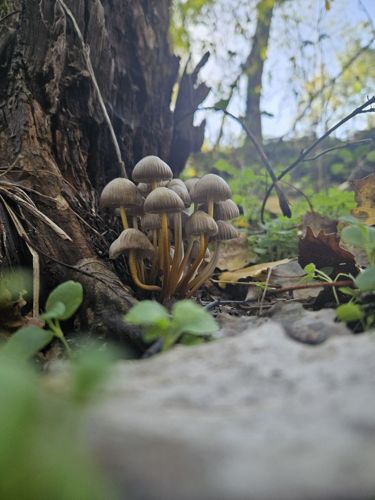
Community find
Clustered Bonnet, Trooping Funnel
Mycena inclinata
- Group
- gilled mushroom
- Season
- Predominantly found in late summer and autumn, often continuing into early winter in milder climates.
- Habitat
- Typically grows in dense clusters on decaying hardwood, especially oak, stumps, logs, and buried wood. It is a saprophytic species.
- Key characteristics
- Caps are typically 1-4 cm in diameter, bell-shaped to conical when young, flattening with age, often with a central umbo. Color varies from grayish-brown to yellowish-brown, often paler at the margin. Gills are adnate to nearly free, close, and white to grayish. Stems are 3-10 cm long, slender, tough, often reddish-brown at the base and paler above, sometimes with fine hairs or fibrils. The base of the stem is typically dark brown or reddish-brown and woolly. Spore print is white.
- Look-alikes
- Other Mycena species, many of which are difficult to distinguish without microscopic examination. Mycena galericulata (Rosy Bonnet) is similar but typically grows on conifer wood and has a more prominent umbo and often different gill attachment. Mycena haematopus (Bleeding Mycena) exudes a reddish juice when cut. Distinguishing features for Mycena inclinata include its clustered growth on hardwood, particularly oak, and the reddish-brown, hairy base of the stipe.
- Ecological role
- This mushroom is a saprophyte, playing a crucial role in breaking down dead hardwood, particularly oak. It recycles nutrients back into the ecosystem, contributing to soil health and forest decomposition processes.