Community find
Common Earthball
Scleroderma citrinum
- Group
- Puffball-like mushroom
- Season
- Late summer through autumn, often persisting into early winter in some regions.
- Habitat
- Typically found growing on the ground, often in disturbed soil, roadsides, heaths, woodland edges, and sometimes in gardens. It can be found in both coniferous and deciduous forests, often preferring acidic soils.
- Key characteristics
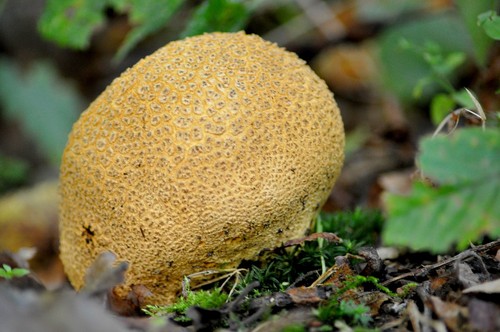
- The fruit body is typically 2-10 cm (0.8-4 in) wide, spherical to somewhat flattened, and often has a thick, tough, and warty or scaly yellowish-brown to tan outer skin. The interior (gleba) is initially white, firm, and solid, but as it matures, it darkens to purplish-black and becomes packed with spore mass, eventually powdery. Unlike true puffballs, it does not have an opening for spore release; instead, the skin usually tears irregularly to disperse spores. It lacks a visible stem, attaching to the substrate by a tough, cord-like mycelial base.
- Look-alikes
- Similar species include other Scleroderma species, such as Scleroderma verrucosum (which has a more distinct stalk-like base and often deeply cracked or scaly surface) and Scleroderma areolatum (smaller, with a finely cracked surface). Young specimens might be confused with true puffballs (Lycoperdon spp.) before the gleba darkens; however, true puffballs have a soft, fleshy interior that remains white or yellowish until spores mature, and they typically have a distinct pore at the top for spore release.
- Ecological role
- Scleroderma citrinum is a mycorrhizal fungus, forming a beneficial symbiotic relationship with the roots of various trees, particularly oak, pine, spruce, and birch. It aids the host plant in nutrient and water uptake from the soil. It also contributes to nutrient cycling in its ecosystem through its mycorrhizal associations.