Community find
Deceiver
Laccaria laccata
- Group
- gilled mushroom
- Season
- Typically found from summer to late autumn, often after periods of rain. It can be found across a wide range of climates.
- Habitat
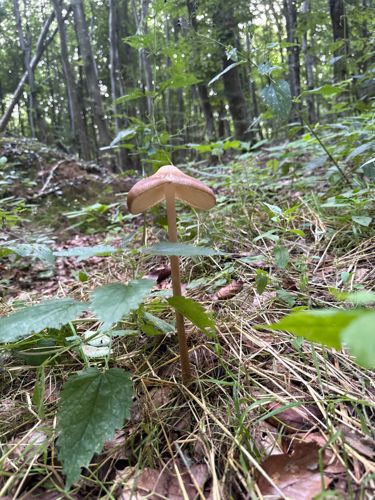
- This mushroom is found growing directly from the forest floor, amidst leaf litter and possibly small twigs or grass. It appears to be solitary. This suggests a terrestrial habit, likely saprophytic on decaying organic matter in broadleaf or mixed woodlands.
- Key characteristics
- The mushroom in the image appears to be a gilled mushroom with a relatively slender stem and a cap that is somewhat bell-shaped or convex, with an uplifted margin in some parts, and a brownish, somewhat translucent color. The gills are visible underneath the cap and appear to be adnexed or adnate, light in color. The stem is thin and appears to be consistent in thickness, beige to light brown, and lacking a prominent ring or volva. The overall size appears to be medium for a forest floor mushroom.
- Look-alikes
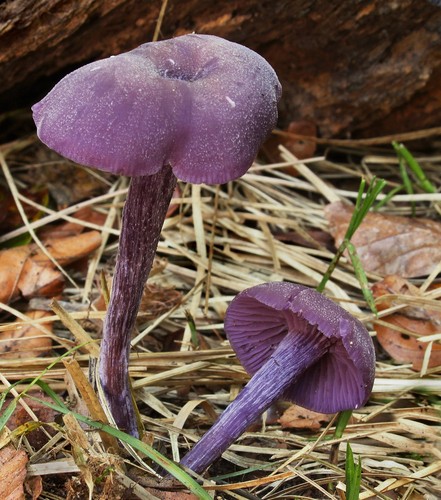
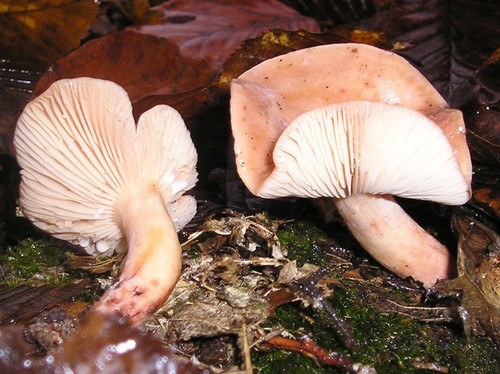
- The Deceiver (Laccaria laccata) is known for its variable appearance, which makes it challenging to identify and gives it its common name. It can be confused with other species within the Laccaria genus, such as Laccaria bicolor (which often has purple tints on the stem base or gills). It might also be confused with certain species of Mycena or Galerina, though careful examination of gill attachment, spore print color (white in Laccaria), and the absence of a ring helps distinguish it. Its often robust though variable stature and sometimes wavy cap margin are also distinguishing features.
- Ecological role
- As with many mushrooms, this species likely plays a crucial role as a decomposer (saprophytic), breaking down organic matter, such as leaf litter and wood debris, enriching the soil and recycling nutrients in the forest ecosystem. It contributes to the decomposition of cellulose and lignin, which are major components of plant material, making nutrients available for other organisms.