Community find
Dog Vomit Slime Mold
Fuligo septica
- Group
- Slime Mold (Amoebozoan)
- Spore print
- Dark brown to blackish
- Size
- 2 to 20 cm in diameter and 1 to 3 cm thick.
- Season
- Late spring, summer, and early autumn, especially after warm, rainy weather.
- Habitat
- Found on decaying wood, logs, tree stumps, and often on wood mulch in garden beds.
- Distribution
- Cosmopolitan; found worldwide on all continents except Antarctica.
- Key characteristics
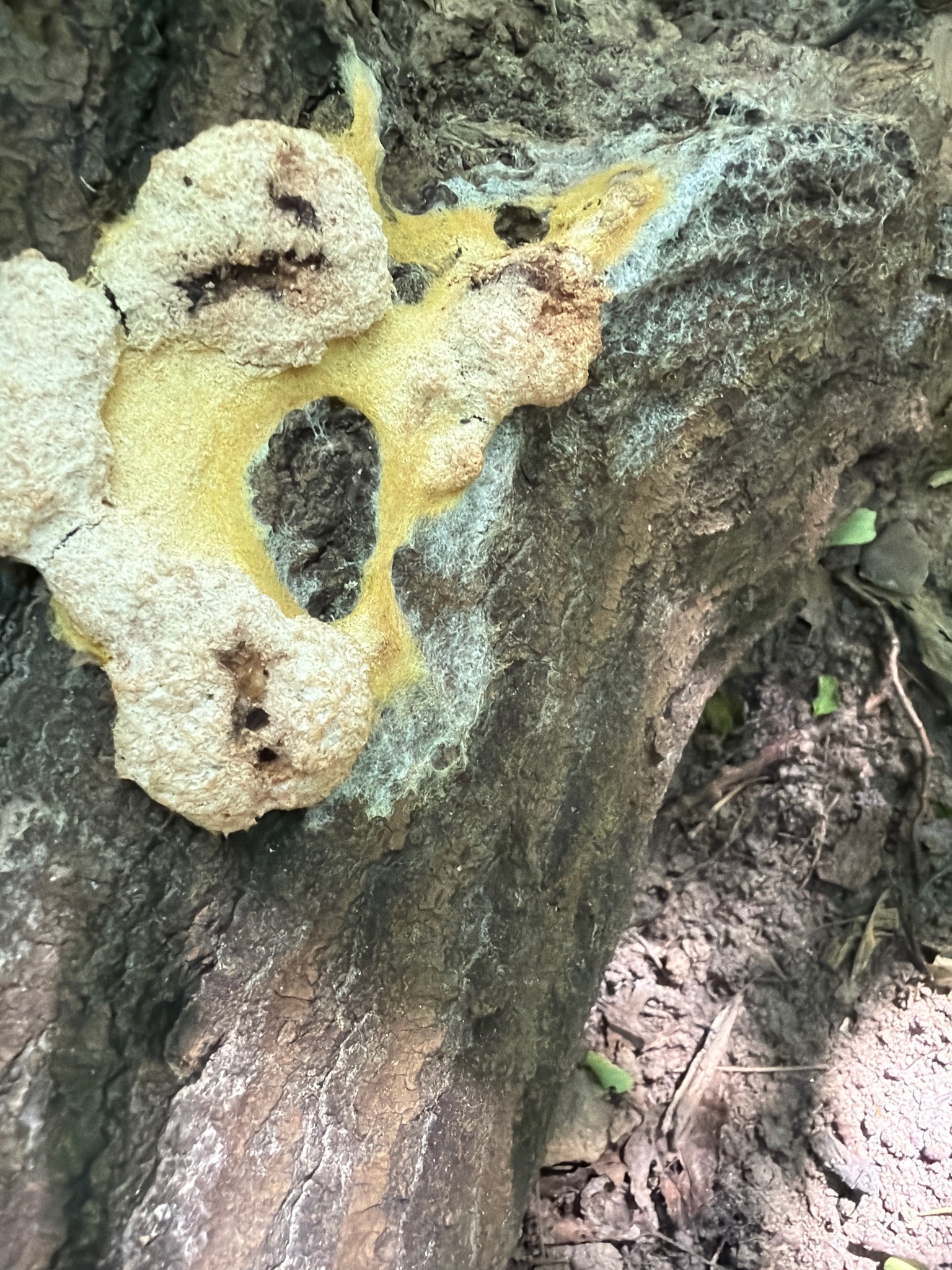
- Appears as a frothy, cushion-like mass (aethalium). Initially bright yellow or creamy white, becoming crusty, brittle, and darker with age. Lacks true stems or gills.
- Fruiting body
- The fruiting body (aethalium) is a sessile, irregular mass (2.5 to 20 cm wide) with a thick, brittle, calcareous crust that eventually cracks to reveal a blackish spore mass inside.
- How to recognise it
- Look for a bright yellow, foamy appearance on wood mulch that turns into a crusty, dry tan or white mass that releases black dust when poked.
- Look-alikes
- Mucilago crustacea (typically whiter and found on grass), and various crust fungi which are harder and non-mobile.
- Ecological role
- Saprophytic/Detritivore; it feeds on bacteria, fungal spores, and decaying organic matter through phagocytosis.
- Notes
- Although studied by mycologists, it is not a true fungus but a protist. It has a 'plasmodium' stage where it can slowly move across surfaces as a single giant cell with millions of nuclei.