Golden Oyster
Pleurotus citrinopileatus
Type: gilled mushroom
Physical Characteristics
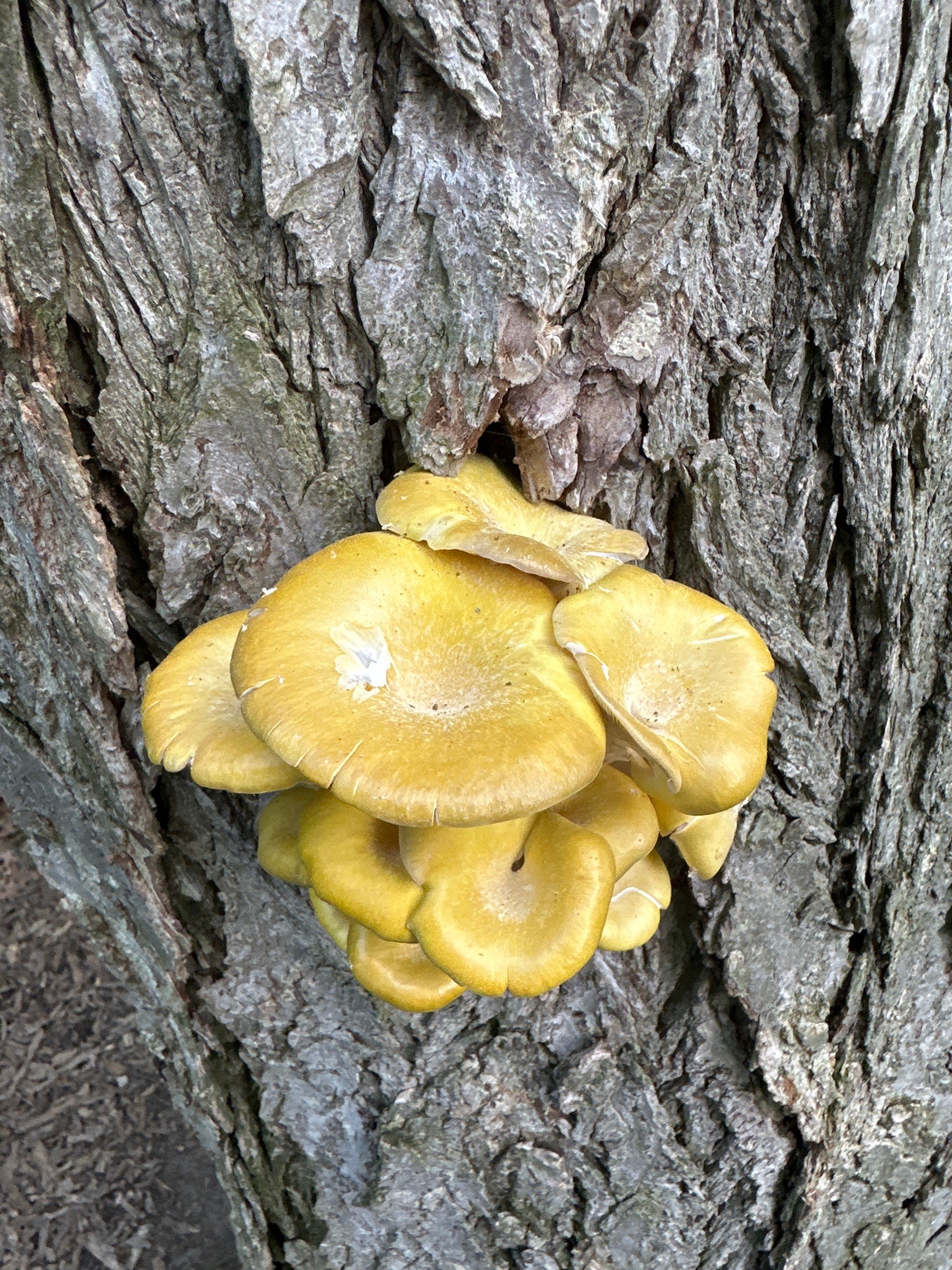
Bright yellow to golden-yellow caps that are funnel-shaped or depressed in the center. Decurrent white gills that run down the stem. Grows in dense cespitose clusters.
Habitat & Growing Conditions
Hardwood logs and dead or dying deciduous trees, particularly elm, oak, and beech.
Season & Fruiting Time
Spring through autumn; fruits in warm, humid conditions.
Similar Looking Species
Pleurotus cornucopiae (pale/cream-colored), Omphalotus olearius (Jack-o'-lantern, orange but grows on ground from roots, has non-decurrent gills and different spore print).
Ecological Role
Saprophytic, breaking down dead hardwood and recycling nutrients into the soil.
Fruiting Body
Cap is 2-8 cm broad, smooth, bright yellow, becoming paler with age; funnel-shaped with an incurved margin. Gills are white, close, and decurrent. Stipe is 2-5 cm long, white to yellowish, often off-center or lateral, and tapering toward the base.
Size
Cap diameter 2-8 cm; Stipe 2-5 cm long, 0.5-2 cm thick.
Spore Print
White to pale pinkish-gray.
Distribution
Native to eastern Russia, northern China, and Japan; widely naturalized in North America (especially the Midwest) due to escaped cultivation.
Identification Tips
Look for the vibrant golden-yellow color, funnel-shaped caps, decurrent white gills, and dense clustering on hardwood logs.
Interesting Facts
It is a popular species for home cultivation kits and laboratory study due to its rapid growth. It has become a highly successful invasive species in parts of the United States, often outcompeting native oyster mushrooms.
Safety reminder
AI mushroom identification is a best-effort estimate and can be wrong. Never use it to decide whether a mushroom is safe to handle or eat — always confirm with a qualified mycologist before any consumption.
Identified on: 5/19/2026
Mode: Standard