Field Mushroom, Meadow Mushroom
Agaricus campestris
Type: gilled mushroom
Physical Characteristics
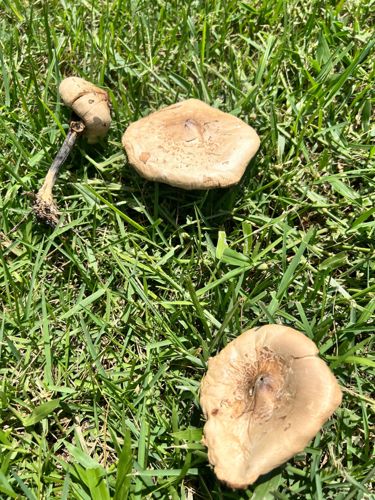
The species typically has a convex to flattened cap, often brownish-tan to yellowish-brown, which can be smooth or slightly scaly. The gills are free and can range from white to pinkish to dark brown depending on maturity. The stem is generally central, often with a ring (annulus) that may disappear with age. The flesh is white and may bruise or stain. Spore print color can vary from dark brown to purple-brown to blackish.
Habitat & Growing Conditions
Found widely across North America, Europe, and Australia, it commonly grows terrestrially in grassy areas such as lawns, parks, meadows, and along roadsides. It can appear solitary or in scattered groups, often fruiting after rainfall.
Season & Fruiting Time
Typically found from spring through autumn, especially after periods of rain. Its growth is favored by moderate temperatures and sufficient moisture.
Similar Looking Species
Similar species include other Agaricus species like Agaricus arvensis (Horse Mushroom) which is larger and has a stronger anise smell, and Agaricus xanthodermus (Yellow Stainer) which stains yellow when bruised and has an unpleasant phenolic odor. It can also be confused with species of Chlorophyllum, especially Chlorophyllum molybdites (Green-spored Lepiota or False Parasol), which has green spores and gills and is a common cause of mushroom poisoning; careful examination of spore print color is essential for differentiation.
Ecological Role
This mushroom is saprophytic, meaning it obtains nutrients by decomposing organic matter. It plays an important role in nutrient cycling in its habitat, breaking down dead plant material and returning nutrients to the soil.
Safety reminder
AI mushroom identification is a best-effort estimate and can be wrong. Never use it to decide whether a mushroom is safe to handle or eat — always confirm with a qualified mycologist before any consumption.
Identified on: 7/22/2025
Mode: Standard