Psilocybe cubensis (sometimes referred to as 'Golden Teacher' variety based on common anecdotal cultivation names for certain forms, though 'Golden Teacher' is not a scientific designation)
Psilocybe cubensis
Type: gilled mushroom
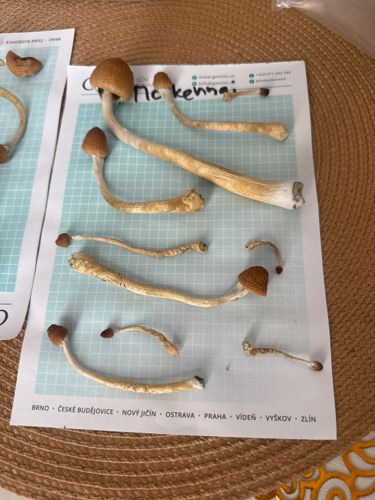
Physical Characteristics
The image displays several specimens of varying sizes. They generally feature a conical to campanulate cap, changing to convex or nearly flat with age, typically a shade of light brown to golden brown when fresh, often becoming lighter towards the margin. The caps can appear somewhat hygrophanous, meaning their color changes depending on their hydration level. The stems are slender, often wavy or curved, and can be whitish to yellowish, sometimes with bluing areas, particularly near the base. Evidence of a partial veil, which can leave an ephemeral annulus (ring) on the upper part of the stem, may be present. The gills underneath the cap are typically adnate to adnexed and can range from pallid to purplish-brown as spores mature.
Habitat & Growing Conditions
This species is commonly found growing in dung or on rich, fertilized soils. It can often be observed in pastures, fields, and grasslands where herbivores graze, as its preferred substrate is animal droppings, particularly cow or horse manure. It may also grow in gardens or other areas with highly organic, nutrient-rich soil.
Season & Fruiting Time
Typically found from late spring through fall, primarily when temperatures are warm and humidity is high. Fruiting is often prolific after periods of rain.
Similar Looking Species
Several other Psilocybe species can look similar, such as Psilocybe subaeruginosa or Psilocybe cyanescens, but these generally have different habitat preferences (e.g., wood chips) or distinct physical characteristics. Galerina marginata (deadly poisonous) is a look-alike that grows on wood, not dung, and has rusty brown spores; careful examination of spore print and habitat is crucial for differentiation. Panaeolus cyanescens is another dung-loving species, but its cap is typically smaller and more slender, and its gills are mottled grey to black.
Ecological Role
This mushroom is saprophytic, meaning it obtains nutrients by decomposing organic matter. It plays a crucial role in nutrient cycling in its ecosystem, breaking down dead plant material, particularly dung or rich soils, thereby returning essential nutrients to the environment. This decomposition process enriches the soil and makes nutrients available for other organisms.
Safety reminder
AI mushroom identification is a best-effort estimate and can be wrong. Never use it to decide whether a mushroom is safe to handle or eat — always confirm with a qualified mycologist before any consumption.
Identified on: 7/22/2025
Mode: Standard