Mycena
Mycena species
Type: Gilled mushroom
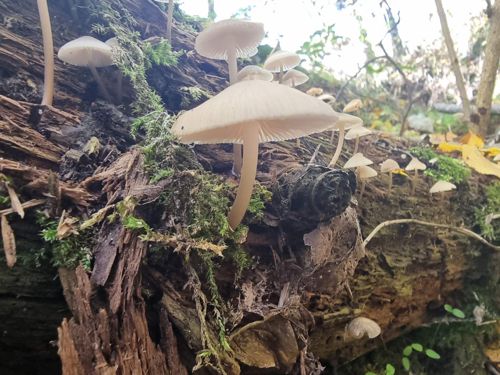
Physical Characteristics
These mushrooms typically have small, conical to bell-shaped, or convex caps, often translucent and striate (grooved) near the margin when moist. The cap color can vary widely within the genus, but in this image, they appear to be light cream to white. They possess thin, fragile stems, usually hollow, and often grow in clusters. Gills are typically adnate (broadly attached to the stem) or adnexed (narrowly attached), frequently widely spaced, and white to pale. The overall size is small, with cap diameters usually ranging from 0.5 to 3 cm. Spore print color is usually white.
Habitat & Growing Conditions
Mycena species are primarily saprophytic, meaning they decompose dead organic matter. They are commonly found growing on decaying wood (logs, branches, stumps), leaf litter, or other organic debris in forests. They prefer moist conditions.
Season & Fruiting Time
Mycena species can be found throughout the growing season, from spring to late autumn, depending on the specific species and local climate. They often fruit after rain and in periods of high humidity.
Similar Looking Species
There are many species within the genus Mycena, and distinguishing them often requires microscopic examination. Some species of Marasmius or other small white-spored gilled mushrooms could appear superficially similar, but typically differ in gill structure, stem characteristics, or ecological preferences. Due to the sheer number of Mycena species, accurate identification to species without further detail is challenging.
Ecological Role
Mycena species are important decomposers in forest ecosystems. As saprophytes, they play a crucial role in breaking down dead wood and other plant material, thereby recycling nutrients back into the soil, which benefits other plants and organisms. They contribute significantly to the health and nutrient cycling of their respective habitats.
Safety reminder
AI mushroom identification is a best-effort estimate and can be wrong. Never use it to decide whether a mushroom is safe to handle or eat — always confirm with a qualified mycologist before any consumption.
Identified on: 11/3/2025
Mode: Standard