Honey Fungus
Armillaria mellea
Type: gilled mushroom
Physical Characteristics
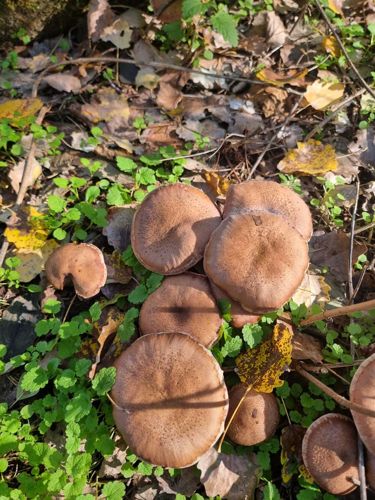
Caps are typically 5-15 cm in diameter, convex to flat with age, yellowish-brown to honey-brown, often with darker scales, especially when young. Gills are whitish to yellowish, attached to slightly decurrent. Stems are usually 5-20 cm long and 1-3 cm thick, fibrous, often tapering towards the base, with a prominent ring (annulus) which can be persistent or disappear with age. Spore print is white.
Habitat & Growing Conditions
Found on living trees, dead wood (both deciduous and coniferous), stumps, and roots. It is a parasitic fungus that can cause white rot in wood, eventually leading to the death of the host tree. Often grows in dense clusters.
Season & Fruiting Time
Late summer to autumn, typically from August to November, depending on the region and climate conditions. Fruiting is often triggered by cool, wet weather.
Similar Looking Species
Several species of Armillaria can look similar, such as Armillaria gallica (often has a bulbous base and a more persistent ring) and Armillaria ostoyae (often darker and more scaly). Other brown-capped clustered mushrooms like Hypholoma and Pholiota species can also resemble it, but they typically have different gill and spore print colors (e.g., purplish-brown/dark brown for Hypholoma, rusty-brown for Pholiota).
Ecological Role
Primarily a parasitic and saprophytic fungus. As a parasite, it can cause Armillaria root rot, a destructive disease of trees and shrubs, leading to tree decline and death. As a saprophyte, it decomposes dead wood, recycling nutrients back into the ecosystem. It also forms extensive mycelial networks (rhizomorphs, or 'bootlaces') that can spread underground for long distances.
Safety reminder
AI mushroom identification is a best-effort estimate and can be wrong. Never use it to decide whether a mushroom is safe to handle or eat — always confirm with a qualified mycologist before any consumption.
Identified on: 11/3/2025
Mode: Standard