American Slender Caesar
Amanita armillariiformis
Type: gilled mushroom
Physical Characteristics
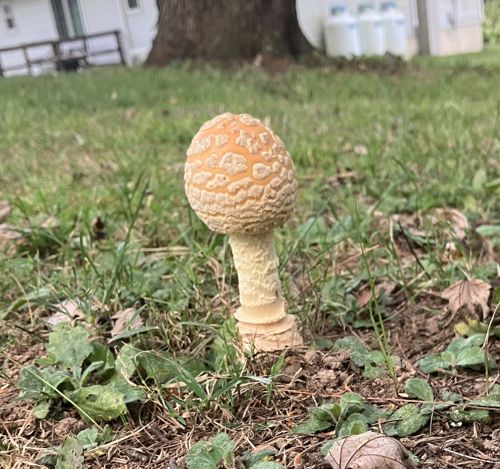
Cap is typically orange-brown to yellow-orange, initially ovate to convex, becoming broadly convex to nearly flat with age. It is covered with numerous, pale to yellowish, flocculose-verrucose patches or warts, remnants of a universal veil, which may wash off with rain. Gills are free or narrowly attached, crowded, yellowish to pale orange. The stem is solid, central, tapering slightly upwards, with a cottony-flocculose to somewhat scaly surface, often yellowish. A skirt-like, yellowish to pale orange ring (annulus) is present, often striate above. The volva at the base is typically sac-like, white to yellowish, and sometimes buried in the substrate.
Habitat & Growing Conditions
This mushroom is mycorrhizal, forming symbiotic relationships with broadleaf trees, particularly oaks and occasionally pines. It is typically found growing solitarily or scattered in mixed hardwood and coniferous forests, often in grassy areas near trees.
Season & Fruiting Time
It is typically found from summer to early autumn, with fruiting usually occurring after periods of rainfall.
Similar Looking Species
Similar species include other members of the 'Caesar's Mushroom' group, such as Amanita caesarea (European Caesar's Mushroom) and Amanita jacksonii (Jackson's Slender Caesar). A. caesarea usually has a brighter orange to red cap and a thicker, more persistent volva. A. jacksonii often has a more reddish-orange cap and a less pronounced volva. Distinguishing factors often include subtle differences in cap color, veil remnants, and volva characteristics, as well as geographical distribution.
Ecological Role
Amanita armillariiformis is a mycorrhizal fungus, meaning it forms a symbiotic relationship with the roots of certain trees. It helps its host trees absorb water and nutrients from the soil, while in return, the trees provide the fungus with carbohydrates produced through photosynthesis. This relationship is crucial for the health and growth of many forest ecosystems.
Safety reminder
AI mushroom identification is a best-effort estimate and can be wrong. Never use it to decide whether a mushroom is safe to handle or eat — always confirm with a qualified mycologist before any consumption.
Identified on: 9/29/2025
Mode: Standard