Field Mushroom
Agaricus campestris
Type: Gilled mushroom
Physical Characteristics
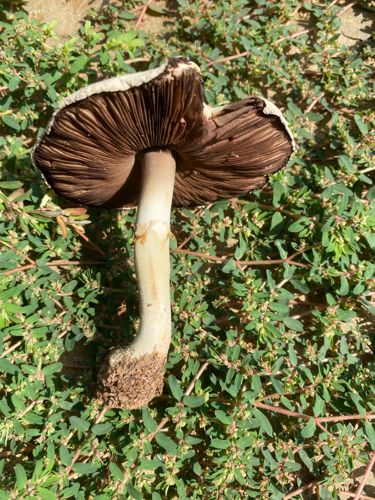
The Field Mushroom typically has a white to brownish cap that can be convex or flattened, often with silky fibers or fine scales. The gills start pink and turn dark brown with age. The stem is white, often tapering slightly towards the base, and has a single, often fleeting, ring. Spore print is dark brown.
Habitat & Growing Conditions
Found in grassy areas, pastures, lawns, and meadows; often growing in rings or scattered groups. It is a saprobic species, deriving nutrients from decaying organic matter in the soil.
Season & Fruiting Time
Commonly found from spring through autumn, especially after rain.
Similar Looking Species
Similar species include other Agaricus species (e.g., Agaricus xanthodermus which stains yellow and has a phenolic odor, unlike A. campestris). Also, species of Macrolepiota, Leucoagaricus, and Chlorophyllum (e.g., Chlorophyllum molybdites, which has green spores).
Ecological Role
This mushroom is saprobic, meaning it plays a crucial role in decomposing organic matter in soils, recycling nutrients back into the ecosystem.
Safety reminder
AI mushroom identification is a best-effort estimate and can be wrong. Never use it to decide whether a mushroom is safe to handle or eat — always confirm with a qualified mycologist before any consumption.
Identified on: 9/7/2025
Mode: Standard