Community find
Fairy Bonnets
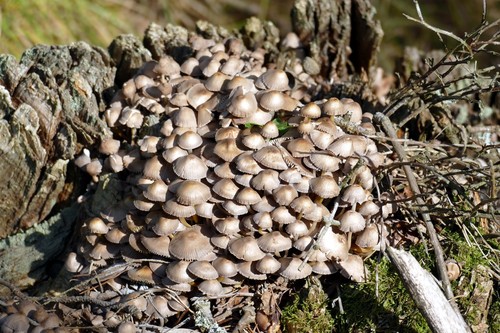
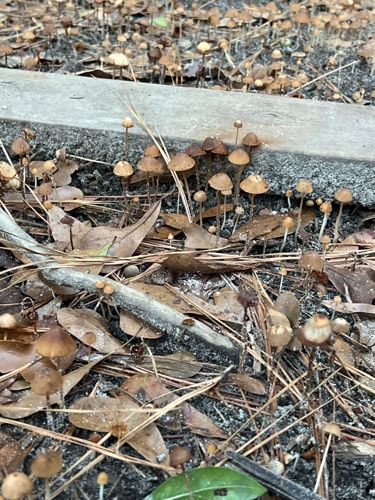
Mycena species (likely Mycena epipterygia or similar small Mycena)
- Group
- gilled mushroom
- Season
- Generally found from late spring through autumn, and even into early winter in milder climates, especially after periods of rainfall.
- Habitat
- Found growing in deciduous and coniferous forests, often on decomposing wood debris, leaf litter, moss, or disturbed soil. They prefer damp, humid conditions.
- Key characteristics
- These mushrooms typically have small, conical to bell-shaped caps, often with a slightly translucent or striate margin, varying in color from light tan to brownish, sometimes with a translucent or 'greasy' appearance when wet. The gills are usually attached to the stem (adnexed) or free, and can be whitish to pale. Stems are slender, often fragile, and can be pale or slightly colored, sometimes showing a translucent or gelatinous quality. Spore print color is usually white.
- Look-alikes
- There are numerous small Mycena species, many of which look very similar. Distinguishing between them often requires microscopic examination of spores and other structures. Other small 'LBMs' (Little Brown Mushrooms) from genera like Galerina, Marasmius, or Conocybe could be confused, but Mycena species usually have distinctive delicate structures and often a translucent, fragile appearance.
- Ecological role
- Fairy Bonnets are saprophytic, meaning they obtain nutrients from decaying organic matter. They play a vital role in nutrient cycling by breaking down dead wood, leaves, and other plant material, thereby returning essential nutrients to the soil for other organisms.