Brown Birch Bolete
Leccinum scabrum
Type: Bolete
Physical Characteristics
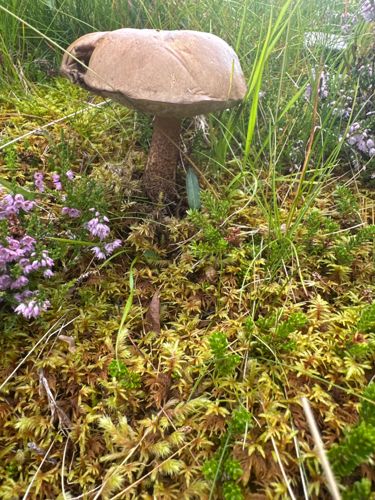
The mushroom has a large, convex to almost flat cap, brownish-gray in color, with a smooth to slightly wrinkled texture. The underside of the cap appears to have pores rather than gills, characteristic of boletes. The stem is robust, tapering slightly upwards, with a textured surface that appears to be fibrous or scruffy, typical of a 'scaber stalk'. The overall color of the stem is a lighter brown than the cap, possibly with darker longitudinal striations or scales.
Habitat & Growing Conditions
The mushroom is growing in mossy ground, likely indicating a boggy or damp woodland, heathland, or moorland environment. The presence of moss and what appears to be heather (Calluna vulgaris) suggests an acid soil. Leccinum species often associate with specific tree hosts; given the common names of similar species, an association with birch or conifers is likely.
Season & Fruiting Time
Typically found from summer to autumn, generally from July through October. Fruiting is dependent on suitable moisture levels and temperature following periods of rain.
Similar Looking Species
There are several other species within the Leccinum genus that can look very similar, such as Leccinum variicolor (Mottled Bolete), which often has a more mottled cap and stains blue-green in the flesh, and other Leccinum species associated with different tree hosts. Leccinum duriusculum (Oak Bolete) is stouter and found under oaks. Distinguishing features often involve specific cap colors, stem markings (scabers), and host tree association. Species in the Leccinum genus are generally characterized by their rough or scaber stem and pore surface rather than gills. Without examining the pore color, spore print, or any blueing reaction, definitive identification to species level can be challenging from an image alone but it strongly resembles a Leccinum scabrum (Brown Birch Bolete). However, it is important to remember that identification to species based on an image is not always definitive and other Leccinum species also share similar physical characteristics, especially those with brown to greyish caps and scaber stems, often found in similar habitats, making precise identification difficult without further examination (e.g. microscopic features or chemical tests). For example, Leccinum holopus (White Birch Bolete) is paler in color, and Leccinum versipelle (Orange Birch Bolete) has a distinctly orange cap and often blue-staining flesh. The general appearance in the image points strongly to a 'Red-capped scaber stalk' or 'Brown Bolete' group, often associated with Birch trees as the common name suggests for Leccinum scabrum. Other bolete genera might also have similar characteristics, but the scaber markings on the stalk are highly indicative of Leccinum. However, it looks like a Leccinum in general due to the scaber stalk, and the cap morphology. More specific ID might need clearer context about the tree species nearby the mushroom but based on morphology, it is definitely a 'scaber stalk' bolete like Leccinum scabrum where the brown cap and habitats are fitting. However, similar boletes often have very specific host trees (birch, oak, aspen, pine) and sometimes subtle differences in cap color/texture, stem scabers, and flesh color changes on cutting, making absolute genus and species identification from a single image difficult without these additional factors. The cap morphology also looks like a Leccinum species, given the visible grooves on the cap indicative of aging and environmental stress, but overall morphology points strongly to the Leccinum genus, possibly within the 'scabrum' group given the dull brown cap and scaber stalk. However, without more information, it is difficult to determine with complete certainty if it is indeed the 'Brown Birch Bolete' versus another Leccinum species. Therefore, the similar species would include other 'scaber stalk' Leccinum species, such as L. niveum, L. griseum, L. variicolor, and L. duriusculum, which can vary in cap color, stem markings, and host tree associations. The distinction often requires examining the color of the pores, the flesh's reaction to cutting (e.g., staining), and the specific type of host tree nearby. The presence of purple heather could indicate an ericaceous host or just a general moorland environment, but the characteristics strongly suggest a Leccinum species, commonly found with birch, aspen, or conifer trees. The distinct scaber (rough) texture on the stem is a key distinguishing feature of the Leccinum genus from other boletes. Given the common appearance and habitat, Leccinum scabrum remains a strong candidate; however, other medium-to-large-sized brown-capped Leccinum species would be considered similar, differing usually by nuances in cap colour, host tree preference, or flesh staining reaction, none of which can be definitively assessed from the provided image. For example, Leccinum versipelle (Orange Birch Bolete) has a distinctly orange cap, while Leccinum testaceoscabrum (Rusty-brown Bolete) has a more reddish-brown cap and often stains blue. The one shown has a dull brownish-gray cap which is more typical of L. scabrum. Given the information and appearance, it's a Leccinum for sure. For similar species, other members of the genus such as L. dunii (often found under aspen and has a paler cap and more robust stem), L. variicolor (mottled cap, often with bluish staining), and L. melaneum (Pinchbeck Bolete, dark cap) are all very similar, mainly differing in cap color, host association, and sometimes subtle flesh reactions that are not visible in the image. Key differentiating features would involve spore print color (usually olive-brown for Leccinum species), microscopic features of the spores, and precise observations of any color changes upon cutting or bruising the flesh, which are not available from the image. However, the prominent 'scabers' (speckle-like scales) on the stem are characteristic of the genus Leccinum and help differentiate it from other non-scaber boletes. Without definitive information on the host tree or flesh reactions, it is challenging to separate some Leccinum species accurately. But the presented mushroom clearly belongs to the group of "scaber stalk" boletes. The overall appearance is highly consistent with Leccinum scabrum, the most common species of this type under birch trees, and other very similar Leccinum species would also fit this general description except for subtle color variations or specific host associations not confirmable by the image alone. The 'scabers' on the stem are a critical feature for identification within the bolete group, pointing to Leccinum rather than other common brown boletes like those in the Boletus or Suillus genera.
Ecological Role
This mushroom is mycorrhizal, forming a symbiotic relationship with the roots of certain trees, often birch. The fungal mycelium extends into the soil, helping the tree absorb water and nutrients, while the mushroom receives carbohydrates produced by the tree through photosynthesis. It plays a vital role in nutrient cycling within the ecosystem, particularly in woodland and heathland environments.
Safety reminder
AI mushroom identification is a best-effort estimate and can be wrong. Never use it to decide whether a mushroom is safe to handle or eat — always confirm with a qualified mycologist before any consumption.
Identified on: 8/8/2025
Mode: Standard