Community find
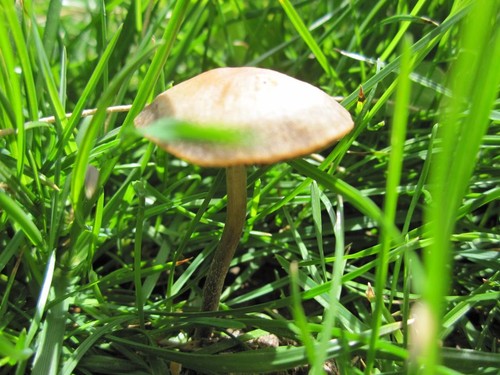
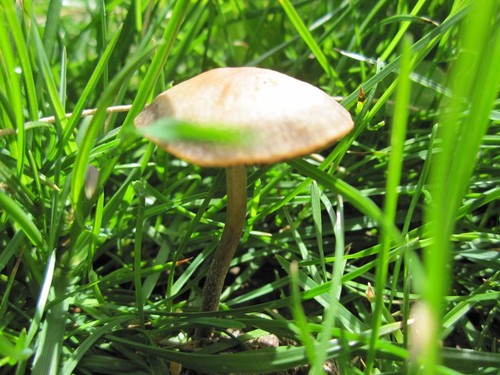
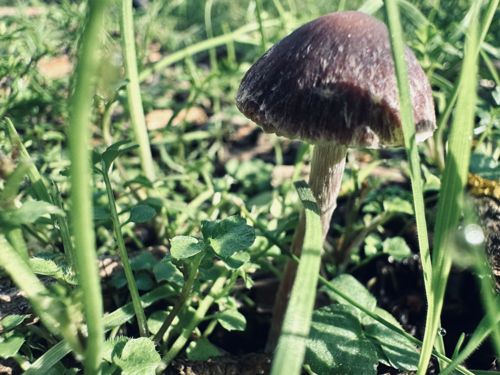
Haymaker's Mushroom
Panaeolus foenisecii
- Group
- gilled mushroom
- Season
- Typically found in late spring through autumn, frequently appearing after heavy rainfall or morning dew.
- Habitat
- Commonly found in lawns, grassy areas, parks, and meadows; prefers well-watered, nutrient-rich soil often associated with grass roots.
- Key characteristics
- Small, convex to bell-shaped cap, 1–3 cm wide; cap color varies from dark brown to buffalo-brown when moist, fading to a lighter tan as it dries (hygrophanous). Gills are broad, closely spaced, and often appear mottled brown. The stem is slender, 4–8 cm long, hollow, and brownish. Spore print is dark smoky brown to black.
- Look-alikes
- Panaeolus cinctulus (which has a jet-black spore print and thicker stem) and various species of the Conocybe genus (which have cinnamon-brown spore prints).
- Ecological role
- Saprophytic mushroom that decomposes dead organic matter, particularly grass thatch and leaf litter, recycling nutrients back into the soil ecosystem. It is an important decomposer in urban and suburban lawn environments. It also serves as a food source for various insects and small invertebrates in the grassland food web. Scientists and mycologists use this species for studies in fungal distribution and spore morphology due to its ubiquity in human-disturbed habitats.