Community find
Honey Fungus
Armillaria mellea
- Group
- gilled mushroom
- Season
- Late summer to late autumn, often after periods of rain.
- Habitat
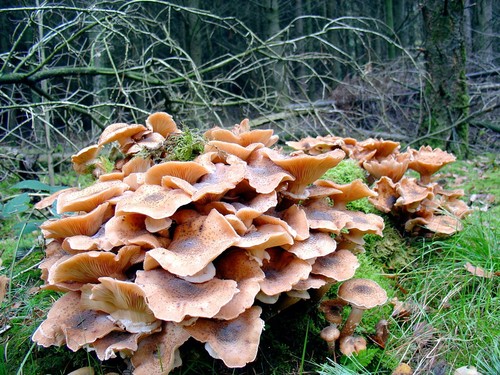
- Found in clusters on living or dead wood of many deciduous and coniferous trees, stumps, and buried roots. They are parasitic on living trees and saprobic on dead wood.
- Key characteristics
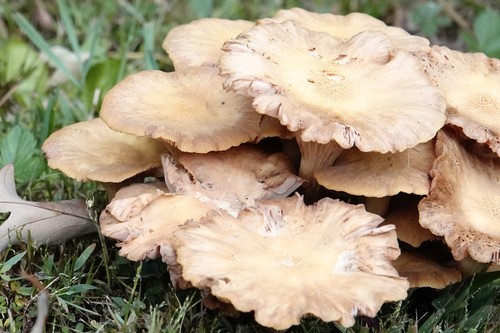
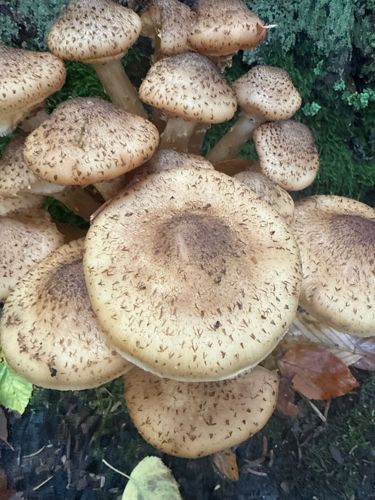
- Caps typically 3-15 cm across, convex to flat, often with a central umbo, yellow-brown to brown, covered with small, dark, fibrous scales. Gills are adnate to decurrent, white to creamy, darkening with age. Stems are 5-20 cm long, 1-3 cm thick, fibrous, often narrowing towards the base, same color as the cap or lighter, with a persistent white to yellowish ring (annulus) that often has a thick, cottony texture. Spore print is white to cream.
- Look-alikes
- Several species of Armillaria are morphologically similar and are often grouped under the common name 'Honey Fungus'. Galerina marginata (Autumn Skullcap) is a deadly toxic mushroom that can sometimes grow on wood and resemble young honey fungi, but it typically has a brown spore print and lacks the prominent ring of Armillaria mellea. Pholiota squarrosa (Shaggy Scalycap) is another similar looking species, but it has a less prominent ring and typically grows on wood. Desarmillaria tabescens (Ringless Honey Fungus) looks very similar but lacks a ring on the stem.
- Ecological role
- A significant parasitic fungus, causing white rot on tree roots and butts, leading to tree decline and death. It also acts as a saprophyte, decomposing dead wood, returning nutrients to the soil. It spreads via rhizomorphs ('bootlaces'), which are root-like structures that can travel through soil to infect new hosts.