Community find
Honey Fungus
Armillaria mellea
- Group
- gilled mushroom
- Season
- Late summer to late autumn, often after periods of rain.
- Habitat
- Found growing in dense clusters on living trees, stumps, and buried wood of a wide range of deciduous and coniferous trees. It is a parasitic and saprophytic fungus, capable of decaying both heartwood and sapwood.
- Key characteristics
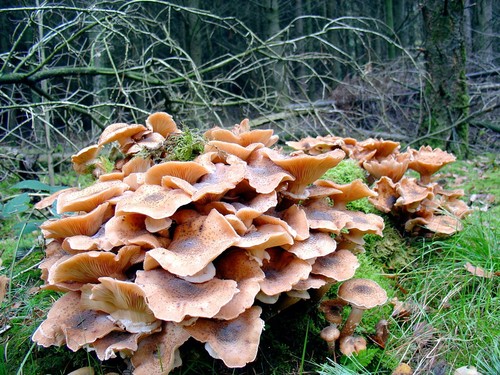
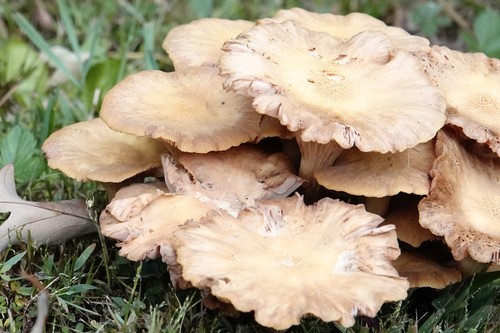
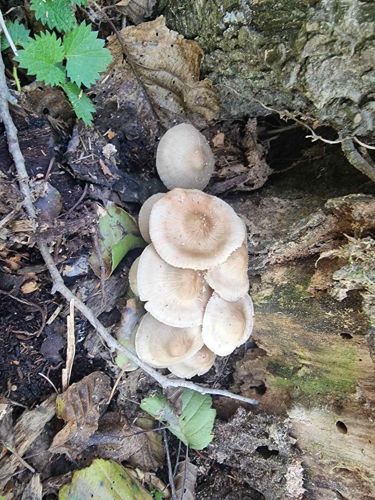
- Caps are typically 3-15 cm in diameter, convex to flat with an umbo, and vary in color from yellowish-brown to honey-brown, often darker towards the center. The surface can be scaly, especially when young. Gills are adnexed to subdecurrent, white to creamy, sometimes developing rusty spots. Stipes (stems) are 5-20 cm long and 1-3 cm thick, fibrous, often slightly swollen at the base, and can be brown or yellowish. A prominent, persistent ring (annulus) is present near the top of the stipe, which is typically white with a yellowish, cottony underside. Spore print is white to cream.
- Look-alikes
- Several species of Armillaria look similar and are often grouped under the common name 'honey fungus'. Armillaria ostoyae typically has darker, more pronounced scales on its cap. Pholiota species might look similar but usually have a more viscid (sticky) cap and a greenish-yellow spore print. Galerina marginata can be confused due to similar habitat but has a rusty-brown spore print and lacks the prominent ring of Armillaria mellea.
- Ecological role
- Armillaria mellea can be a significant forest pathogen, causing root rot and white rot in a wide variety of tree species, functioning as a parasite. It also acts as a saprophyte, breaking down dead wood and contributing to nutrient cycling in forest ecosystems. It spreads extensively through rhizomorphs (black, shoestring-like structures) under the bark or in the soil, allowing it to colonize new plant material.