Community find
Honey Fungus
Armillaria mellea
- Group
- Gilled Mushroom
- Season
- Late summer to late autumn, typically after periods of rain.
- Habitat
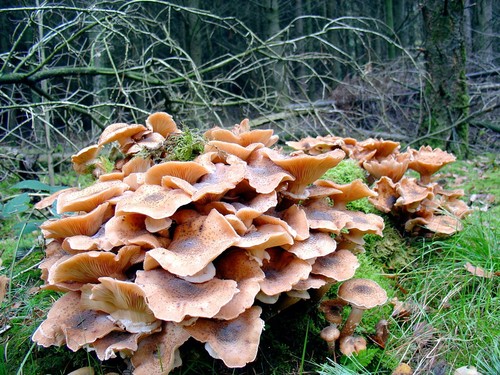
- Found growing in dense clusters on dead or living deciduous and coniferous wood, often at the base of trees or on buried wood. It is a parasitic fungus.
- Key characteristics
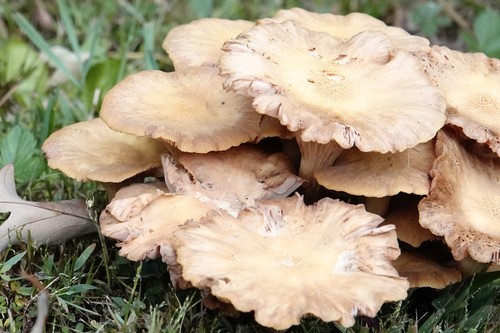
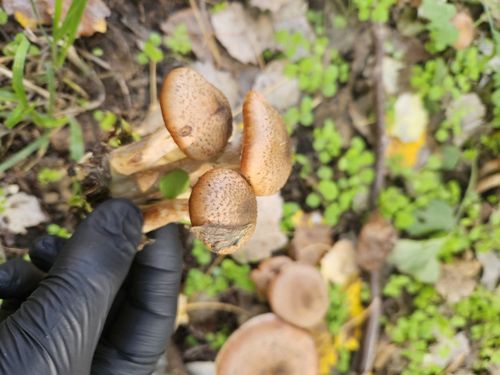
- Caps typically 3-15 cm wide, convex to flattened, varying in color from yellow-brown to olive-brown, often with small, darker scales, especially when young. Gills are attached to slightly decurrent, whitish to yellowish, sometimes developing rusty spots. Stems are 5-20 cm long, 0.5-3 cm thick, fibrous, often tapering downwards, with a persistent ring (annulus) that starts white and darkens with age. Spore print is white to cream.
- Look-alikes
- There are several species in the Armillaria genus that look similar, collectively known as 'Honey Fungi'. Other lookalikes can include Pholiota species, which often have brownish spore prints and lack the characteristic ring of Armillaria.
- Ecological role
- Primarily a parasitic fungus, causing white rot in trees, leading to their decay and eventual death. It can also be saprophytic, decomposing dead wood. It plays a significant role in nutrient cycling in forest ecosystems.