Community find
Honey Fungus
Armillaria mellea
- Group
- gilled mushroom
- Season
- Late summer to autumn, typically from August to November, depending on the region and climate conditions. Fruiting is often triggered by cool, wet weather.
- Habitat
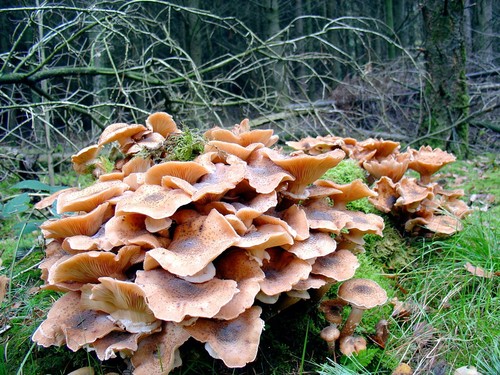
- Found on living trees, dead wood (both deciduous and coniferous), stumps, and roots. It is a parasitic fungus that can cause white rot in wood, eventually leading to the death of the host tree. Often grows in dense clusters.
- Key characteristics
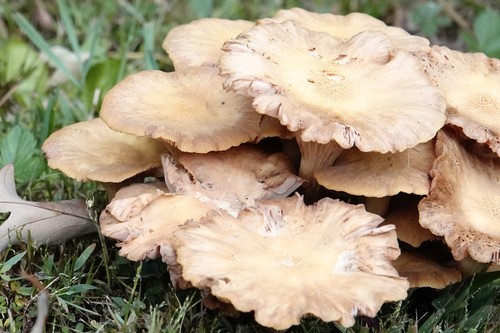
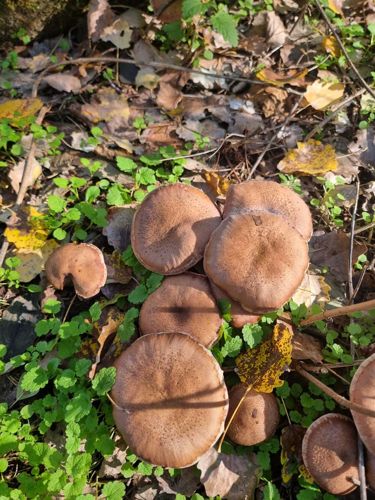
- Caps are typically 5-15 cm in diameter, convex to flat with age, yellowish-brown to honey-brown, often with darker scales, especially when young. Gills are whitish to yellowish, attached to slightly decurrent. Stems are usually 5-20 cm long and 1-3 cm thick, fibrous, often tapering towards the base, with a prominent ring (annulus) which can be persistent or disappear with age. Spore print is white.
- Look-alikes
- Several species of Armillaria can look similar, such as Armillaria gallica (often has a bulbous base and a more persistent ring) and Armillaria ostoyae (often darker and more scaly). Other brown-capped clustered mushrooms like Hypholoma and Pholiota species can also resemble it, but they typically have different gill and spore print colors (e.g., purplish-brown/dark brown for Hypholoma, rusty-brown for Pholiota).
- Ecological role
- Primarily a parasitic and saprophytic fungus. As a parasite, it can cause Armillaria root rot, a destructive disease of trees and shrubs, leading to tree decline and death. As a saprophyte, it decomposes dead wood, recycling nutrients back into the ecosystem. It also forms extensive mycelial networks (rhizomorphs, or 'bootlaces') that can spread underground for long distances.