Community find
Honey Fungus
Armillaria mellea sensu lato
- Group
- Gilled mushroom
- Season
- Typically found from late summer through late autumn, especially after periods of rain.
- Habitat
- Honey fungus is a parasitic and saprophytic fungus that grows on and around the base of a wide range of living trees, shrubs, and dead wood, including stumps and buried wood. It can be found in forests, woodlands, gardens, and urban areas.
- Key characteristics
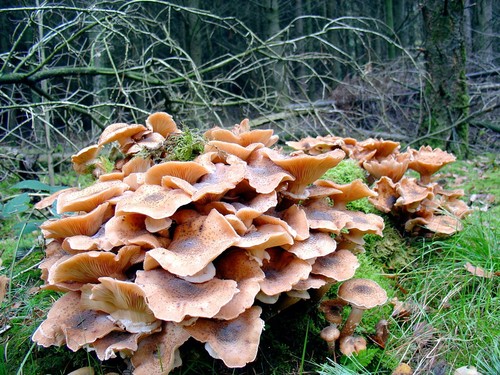
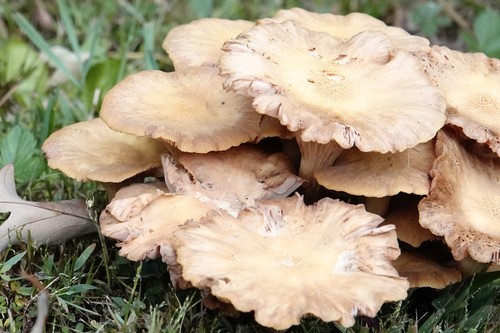
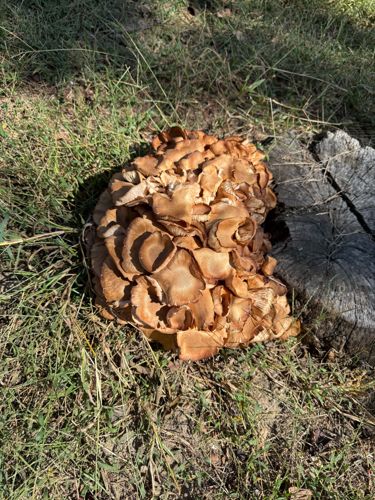
- Honey fungus appears in dense clusters on wood. The caps are typically honey-yellow to brownish, convex to flat, often with small, darker scales, especially when young. Gills are whitish to yellowish. The stem is fibrous, often tapering towards the base, and usually has a ring (annulus) that can be thin and wispy or more substantial. The spore print is white. The overall appearance can vary significantly based on environmental conditions and age.
- Look-alikes
- Several species are commonly referred to as 'honey fungi,' and distinguishing between them can be challenging without microscopic examination or DNA sequencing. Galerina marginata (Deadly Galerina) can look superficially similar when growing on wood, but it has a brownish spore print and lacks the robust ring and overall cluster size of Armillaria. Pholiota species sometimes grow in clusters on wood but typically have a darker, rusty-brown spore print and often more scaly caps.
- Ecological role
- Armillaria mellea is a significant wood-decay fungus. It acts as both a pathogen and a saprophyte. As a pathogen, it causes root rot in many species of trees and shrubs, leading to their decline and death. As a saprophyte, it decomposes dead wood, recycling nutrients back into the ecosystem. It spreads through spores and also via black, shoelace-like rhizomorphs, which can grow through the soil and infect new hosts.