Field Mushroom
Agaricus campestris
Type: gilled mushroom
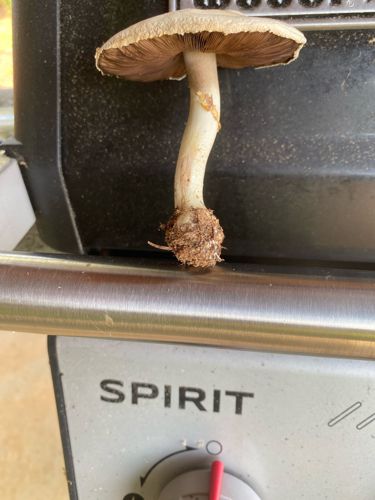
Physical Characteristics
The cap of Agaricus campestris is typically 5-10 cm in diameter, initially convex, flattening with age, and can range from white to creamy-brown, sometimes with fine fibrils or scales. The gills beneath the cap are initially pink, becoming chocolate brown to black with maturity due to the color of the spores. The stem is central, 3-7 cm tall, and 1-2 cm thick, often tapering slightly towards the base, and white or cream-colored. It typically has a single, often fragile, partial veil that usually forms a ring (annulus) on the stem, which can be easily detached or absent in older specimens. The base of the stem may have some attached soil or debris.
Habitat & Growing Conditions
Agaricus campestris is a saprophytic fungus, growing on rich, well-fertilized soil, often in grassy areas such as meadows, pastures, parks, and lawns. It can also be found in cultivated fields and gardens. It prefers disturbed ground and nutrient-rich substrates, often appearing in rings or scattered groups.
Season & Fruiting Time
This mushroom is typically found from late spring through autumn, with peak fruiting often occurring in late summer and early fall, especially after rain.
Similar Looking Species
Several species from the genus Agaricus can look similar, especially other white gilled mushrooms. Care should be taken to distinguish it from the Yellow-staining Mushroom (Agaricus xanthodermus), which stains yellow when bruised and has a phenolic odor. Other white-capped mushrooms like species of Amanita (which often have a volva or different gill attachment) or some unpalatable Lepiota species can also be mistaken, but their spore print and other features differ significantly. The changing gill color from pink to dark brown/black and the habitat are key identification features for Agaricus campestris.
Ecological Role
Agaricus campestris is a saprophytic fungus, meaning it obtains nutrients by decomposing organic matter in the soil. It plays a significant role in nutrient cycling in its habitat by breaking down complex organic compounds into simpler forms, making them available for plants. This contributes to soil health and fertility, particularly in grassland ecosystems.
Safety reminder
AI mushroom identification is a best-effort estimate and can be wrong. Never use it to decide whether a mushroom is safe to handle or eat — always confirm with a qualified mycologist before any consumption.
Identified on: 9/7/2025
Mode: Standard