Bolete (general)
Boletus (genus)
Type: Bolete
Physical Characteristics
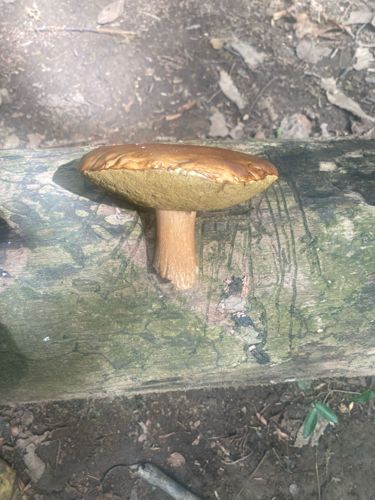
This mushroom appears to be a bolete, characterized by the presence of pores instead of gills under the cap. The cap is broad and convex, with a brownish-golden color and a smooth to slightly velvety texture. The underside shows a yellowish-green pore surface. The stalk is relatively thick and central, appearing light brown to tan, and seems to lack any prominent net-like pattern (reticulation) or ring. The overall size appears medium to large, suitable for a bolete.
Habitat & Growing Conditions
Boletes are typically found on the ground in woodlands and forests, forming mycorrhizal associations with various tree species, often conifers or deciduous trees like oak, pine, spruce, or birch. The image shows it growing on what appears to be a decaying log or tree trunk, which is less common for strictly mycorrhizal boletes but could suggest a saprobic or facultatively mycorrhizal species, or simply a fallen specimen near its host.
Season & Fruiting Time
Most bolete species fruit from late spring through autumn, with peak season often in late summer and early fall, particularly after periods of rain. Specific timing can vary depending on geographical location and local climate conditions.
Similar Looking Species
Many bolete species can look similar, making identification to species level challenging without examining additional features like pore bruising reaction, stalk reticulation, flesh color changes upon cutting, and microscopic characteristics. Some potentially similar genera include Xerocomellus, Leccinum, and Suillus, which also have pores. Key distinguishing features would include checking for blue staining on pores or flesh when bruised, the presence and nature of reticulation on the stipe, and the habitat (e.g., specific tree associations). Without more detailed features visible, precise identification is difficult beyond the general bolete category. For example, some species of Baorangia, Hemileccinum, or Imleria might have similar appearances given the visible features, but definitive identification requires closer inspection of microscopic and macroscopic details not fully discernible here. The visible pores rule out gilled mushrooms (e.g., Amanita, Russula) and other pore-bearing fungi like polypores (which typically grow directly on wood and are often tougher) or puffballs (which are spherical). The general appearance is most consistent with a terrestrial bolete that may have fallen onto the log or is growing very close to it, rather than a truly lignicolous fungus directly consuming the wood.
Ecological Role
Boletes are primarily mycorrhizal fungi, forming symbiotic relationships with the roots of trees. They help host trees absorb water and nutrients, particularly phosphorus and nitrogen, while receiving carbohydrates synthesized by the tree through photosynthesis. This mutualistic relationship is vital for the health and growth of many forest ecosystems, acting as decomposers of organic matter and facilitating nutrient cycling.
Safety reminder
AI mushroom identification is a best-effort estimate and can be wrong. Never use it to decide whether a mushroom is safe to handle or eat — always confirm with a qualified mycologist before any consumption.
Identified on: 7/23/2025
Mode: Standard