Greasy Toughshank
Rhodocollybia butyracea
Type: gilled mushroom
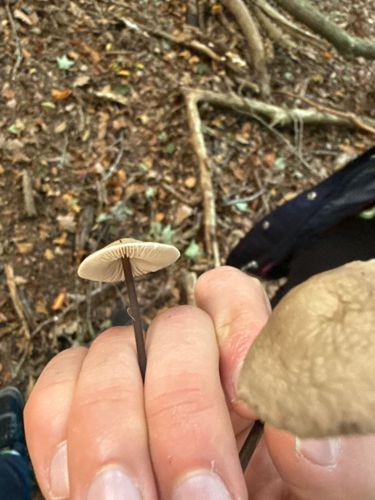
Physical Characteristics
The cap of Rhodocollybia butyracea is typically 2-10 cm in diameter, convex to broadly umbonate, becoming flattened with age. It is smooth, moist, and often greasy or sticky to the touch, especially when wet. The color varies from pale gray-brown to darker reddish-brown or smoky gray, often fading with age and drying. The gills are narrowly attached to free, crowded, and whitish, sometimes developing a pinkish tinge with age due to spore deposits. The stem is 3-10 cm long and 0.3-1 cm thick, often tapering slightly towards the apex and broadening towards the base, which can be somewhat swollen. It is usually whitish above and grayish to brownish below, tough, elastic, and often grooved or twisted. The flesh is white and does not change color when cut or bruised. The spore print is white to creamy.
Habitat & Growing Conditions
Rhodocollybia butyracea is a saprobic fungus, growing on decaying organic matter, typically in leaf litter or on well-rotted wood chips in deciduous or mixed woodlands. It can be found growing solitarily or in scattered groups.
Season & Fruiting Time
This species is most commonly found during late summer and autumn, from August to November, depending on geographical location and local climate conditions. It thrives in cool, moist conditions.
Similar Looking Species
Similar species include other members of the genus Rhodocollybia. Collybia dryophila (Oak-loving Collybia) has a more uniformly colored stem and typically grows directly on wood. Marasmiellus candidus can look superficially similar but is generally much smaller and more delicate. Identification often relies on a combination of cap texture, gill attachment, stem characteristics, and substrate.
Ecological Role
As a saprobic fungus, Rhodocollybia butyracea plays an important role in forest ecosystems by decomposing dead organic matter, particularly leaf litter and woody debris. This process recycles nutrients back into the soil, making them available for other plants and organisms, thus contributing to soil health and nutrient cycling.
Safety reminder
AI mushroom identification is a best-effort estimate and can be wrong. Never use it to decide whether a mushroom is safe to handle or eat — always confirm with a qualified mycologist before any consumption.
Identified on: 10/12/2025
Mode: Standard