Bay Bolete
Imleria badia
Type: Bolete
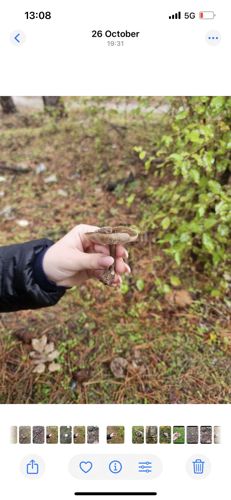
Physical Characteristics
The cap of the Bay Bolete typically ranges from 5 to 15 cm in diameter, initially convex, flattening with age, and can be bay-brown, chestnut-brown, or reddish-brown, often tacky when wet, and smooth. The pores underneath the cap are initially whitish to yellowish, becoming greenish-yellow with age, and bruise blue instantly when touched. The stem is usually 5-12 cm long and 1-4 cm thick, cylindrical or somewhat club-shaped, brownish, sometimes with fine longitudinal striations but lacking a prominent net-like pattern (reticulation). The flesh is whitish to yellowish, bruising blue when cut. Its spore print is olive-brown.
Habitat & Growing Conditions
The Bay Bolete is typically found growing on soil, often associated with coniferous trees, particularly pines, but can also be found with deciduous trees like oak and beech. It can grow solitarily or in scattered groups.
Season & Fruiting Time
It is most commonly found during late summer and autumn, often fruiting after periods of rain.
Similar Looking Species
Similar looking species include other boletes. The Chestnut Bolete (Gyroporus castaneus) has a brittle stem and does not bruise blue. Various species of Xerocomellus (many formerly in Boletus or Xerocomus) may appear similar, but often have less prominent bruising and different cap textures. Distinguishing features of Imleria badia include its often sticky bay-brown cap, yellowish pores that rapidly bruise blue, and the absence of strong reticulation on the stem.
Ecological Role
Imleria badia is an ectomycorrhizal fungus, forming a symbiotic relationship with the roots of trees, primarily conifers. The fungus helps its host tree absorb water and nutrients from the soil, especially phosphorus and nitrogen, in exchange for sugars produced by the tree through photosynthesis.
Safety reminder
AI mushroom identification is a best-effort estimate and can be wrong. Never use it to decide whether a mushroom is safe to handle or eat — always confirm with a qualified mycologist before any consumption.
Identified on: 11/3/2025
Mode: Standard