Conocybe
Conocybe species
Type: gilled mushroom
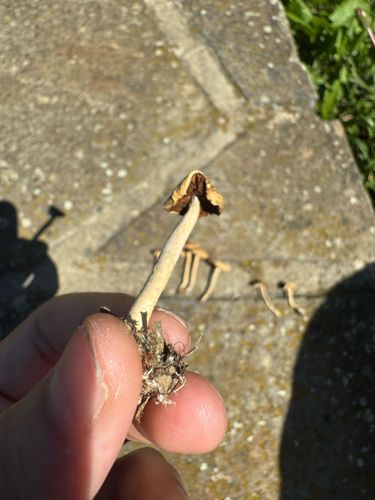
Physical Characteristics
The mushroom in the image appears to have a conical to campanulate (bell-shaped) cap, which is a common characteristic. The cap color seems to be a yellowish-brown or brownish-orange, and it looks somewhat hygrophanous, meaning its color changes with moisture content. The gills are likely adnate to adnexed and can be dark brown to purplish-brown at maturity. The stem is slender, whitish to yellowish-brown, and often has a slight wavy or contorted appearance. There is no visible ring (annulus) on the stem. The overall size is small to medium.
Habitat & Growing Conditions
This type of mushroom typically grows gregariously or in fascicles (small clusters) on disturbed ground, rich soil, lawns, pastures, and sometimes on wood debris. It prefers grassy areas, especially those enriched by animal droppings, and often fruits in urban or suburban settings.
Season & Fruiting Time
While some species can fruit throughout the year in mild climates, many Conocybe species are commonly found from spring through autumn, especially after rain.
Similar Looking Species
Conocybe species can be confused with other small, brown-spored mushrooms, particularly those in the genera Galerina, Agrocybe, and Psilocybe. Distinguishing features include the lack of a veil or ring (though some Conocybe species can have one), the conical cap shape, and microscopic features like the presence or absence of cystidia. Careful examination of gill attachment, spore print color, and habitat is often necessary for accurate identification. For instance, Galerina species often have brownish spore prints and typically grow on wood or moss, while Psilocybe species often have purplish-brown to blackish spore prints and may stain blue when bruised. Agrocybe species often have a more robust stature and typically grow on wood or woody debris with a darker brown spore print.
Ecological Role
Fungi in this genus are primarily saprophytic, meaning they obtain nutrients by decomposing dead organic matter. They play a crucial role in nutrient cycling in their ecosystems, breaking down plant material and returning vital nutrients to the soil.
Safety reminder
AI mushroom identification is a best-effort estimate and can be wrong. Never use it to decide whether a mushroom is safe to handle or eat — always confirm with a qualified mycologist before any consumption.
Identified on: 7/22/2025
Mode: Standard