Berkeley's Polypore
Bondarzewia berkeleyi
Type: Polypore
Physical Characteristics
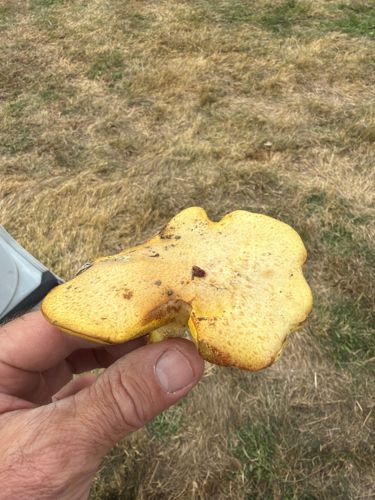
This mushroom typically forms large, overlapping shelf-like or rosette clusters, often at the base of hardwood trees. The caps are usually fan-shaped, grayish-white to yellowish, and can be zoned. The underside features a poroid surface that is white to cream-colored, with small, angular pores. The flesh is tough and fibrous, white, and does not change color when cut. Individual caps can range from 10-60 cm across, and the entire cluster can weigh many kilograms. It has no true stem, but rather a thick, rudimentary base.
Habitat & Growing Conditions
Typically found growing at the base of living deciduous hardwood trees, especially oak, maple, and beech, causing a white heart rot. It can also be found on decaying stumps or buried roots. It prefers temperate forests.
Season & Fruiting Time
Generally found from summer to early autumn, typically from July through September, depending on geographical location and moisture levels.
Similar Looking Species
Similar species include the Black-staining Polypore (Meripilus sumstinei), which stains black when bruised or handled. Another look-alike is the Hen of the Woods (Grifola frondosa), which has a more intricate, cauliflower-like structure and thinner caps, and also typically stains light brown or not at all. The Berkeley's Polypore does not stain significantly upon bruising.
Ecological Role
It is a parasitic white rot fungus, causing decay in the heartwood of living hardwood trees, primarily oaks. It eventually leads to weakening and hollowing of the host tree. It also acts as a decomposer, recycling nutrients back into the ecosystem once the tree dies.
Safety reminder
AI mushroom identification is a best-effort estimate and can be wrong. Never use it to decide whether a mushroom is safe to handle or eat — always confirm with a qualified mycologist before any consumption.
Identified on: 9/21/2025
Mode: Standard