Headless bonnet
Mycena adscendens
Type: gilled mushroom
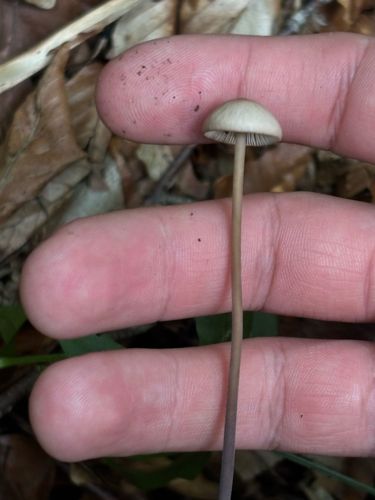
Physical Characteristics
Cap is typically conic to campanulate (bell-shaped), expanding to convex or nearly flat with age, often with a papilla (small nipple-like projection). Color varies from grayish-brown to pale tan or off-white, often hygrophanous (changes color depending on moisture). Gills are adnate to adnexed, close to subdistant, pallid to grayish. The stipe (stem) is very slender, fragile, often pruinose (finely powdered) at the apex, and can be whitish at the top, darkening to grayish-brown or purplish towards the base. Spore print is white to pale.
Habitat & Growing Conditions
Typically found growing scattered or in groups on leaf litter, decaying wood, or humus in deciduous and coniferous forests. They prefer moist environments.
Season & Fruiting Time
Late spring through fall, particularly after periods of rain.
Similar Looking Species
Mycena adscendens can be confused with other small Mycena species. For instance, Mycena vitilis has a similar slender stature but typically lacks the prominent pruinose (powdery) stipe apex and is often found on decaying wood. Mycena arcangeliana is another small species, but it often has a more yellowish tint and a different cap shape. Due to the small size and subtle differences, microscopic examination is often necessary for positive identification among Mycena species.
Ecological Role
Saprophytic, meaning it obtains nutrients from decaying organic matter. It plays a crucial role in nutrient cycling in forest ecosystems by breaking down dead wood and leaf litter.
Safety reminder
AI mushroom identification is a best-effort estimate and can be wrong. Never use it to decide whether a mushroom is safe to handle or eat — always confirm with a qualified mycologist before any consumption.
Identified on: 7/29/2025
Mode: Standard