Deceiver
Laccaria laccata
Type: Gilled mushroom
Physical Characteristics
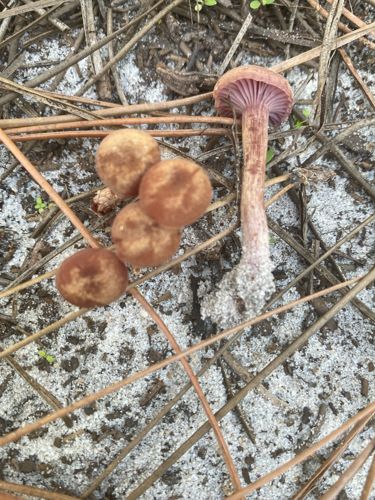
Cap is typically 1-6 cm wide, ranging in color from reddish-brown to orange-brown or buff, often fading with age and drying. It is convex, flattening with age, sometimes with a central depression. The margin can be wavy or lobed. Gills are widely spaced, adnate to subdecurrent, and pinkish-lilac to flesh-colored. The stem is slender, fibrous, often twisted, and colored similarly to the cap, sometimes paler at the base. Spore print is white.
Habitat & Growing Conditions
Found in a wide variety of habitats, including woodlands, forests, gardens, and along paths. It grows terrestrially in soil, often among moss or leaf litter, and forms mycorrhizal associations with many tree species.
Season & Fruiting Time
Commonly found from summer to late autumn, sometimes appearing earlier or later depending on regional climate and rainfall.
Similar Looking Species
There are several species within the Laccaria genus that can appear similar, such as Laccaria amethystina (Amethyst Deceiver), which is distinctively purple. Other brown Laccaria species (e.g., L. proxima) require microscopic examination for definite identification. The 'deceiver' common name refers to its variable appearance.
Ecological Role
Laccaria laccata is a mycorrhizal fungus, forming symbiotic relationships with the roots of various trees (both deciduous and coniferous). This association benefits the tree by improving its access to water and nutrients (especially phosphorus), while the fungus receives carbohydrates from the tree. It plays a significant role in nutrient cycling in forest ecosystems.
Safety reminder
AI mushroom identification is a best-effort estimate and can be wrong. Never use it to decide whether a mushroom is safe to handle or eat — always confirm with a qualified mycologist before any consumption.
Identified on: 12/5/2025
Mode: Standard