
Community find
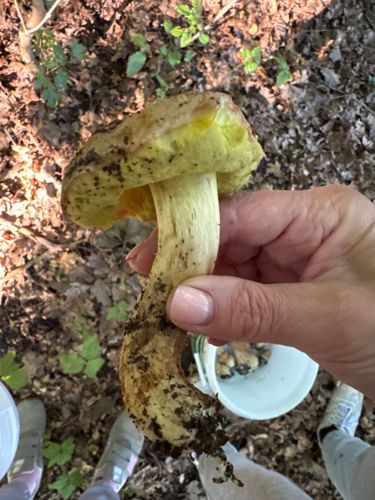
Pale-capped Bolete or Bay Bolete (Note: The image strongly suggests a species similar to a Pale-capped Bolete, possibly within the Xerocomellus or Boletus sensu lato group, but without clear pore surface visibility and spore color, a precise common name is challenging. 'Pale-capped Bolete' is a generalized descriptor for boletes with lighter caps).
Likely a species within the family Boletaceae, potentially genus Xerocomellus or a related genus like *Lanmaoa* or *Boletus* (in its broader sense). A precise species identification (e.g., *Xerocomellus intermedius* or *Lanmaoa pallidorosea*) would require more detailed examination, but given the visible characteristics like the yellow hues, bruising, and general shape, it falls within this group.
- Group
- Bolete
- Season
- Late spring through fall, typically appearing after periods of rain.
- Habitat
- Found singly or scattered on the ground in deciduous and mixed forests, particularly under oak and other hardwood trees. Prefers well-drained soil.
- Key characteristics
- Cap: Typically convex to broadly convex, becoming flat with age. Color ranges from yellowish-brown, tan, to olive-brown, often with hints of yellow, especially towards the margin. Surface can be smooth or slightly velvety, usually dry. Pores: Angular, yellow to olive-yellow, bruising blue upon handling. Stipe: Solid, stout, often bulbous or club-shaped at the base, tapering upwards. Color is typically pale yellow to tan, frequently covered with fine reticulation (net-like pattern) or scabers (small dots or scales). Flesh: Pale yellow, firm, often bruises blue when cut or handled, especially in the cap and upper stipe. Spore Print: Olive-brown.
- Look-alikes
- Many boletes can look similar. Some species with yellow pores and a similar stature include species within the *Boletus* and *Xerocomellus* genera. Distinguishing features often involve looking at the exact shade of yellow of the pores, the presence and color of reticulation or scabers on the stipe, the color changes upon bruising, and the habitat (specific tree associates). For instance, *Boletus edulis* (King Bolete) has a different cap color and texture, and its stipe typically has a prominent white reticulation. Other *Xerocomellus* species might have different cap colors or more pronounced bruising characteristics.
- Ecological role
- Mycorrhizal, forming a symbiotic relationship with the roots of various trees, especially oaks and other hardwoods. This relationship benefits both the fungus and the tree, with the fungus helping the tree absorb water and nutrients, and the tree providing sugars to the fungus. It plays a significant role in nutrient cycling in its forest habitats.